Introduction
Ready for a harsh truth? If your TA team's pipeline depends primarily on job postings and inbound applications, you are accessing, at most, 30% of the qualified talent market. The other 70% — those who are employed, performing, and not actively looking — will never see your job posting, let alone apply to it.
Now, I know what you’re thinking, and this is not a knock on inbound recruiting: A well-structured inbound program is a real asset. But at a certain point, every inbound-only team runs into the same ceiling: you can optimize your job descriptions, your sourcing channels, and your ATS workflow, and you'll still be competing for the same pool of active candidates that every other employer is competing for.
Outbound sourcing changes the competitive dynamic: Instead of waiting to see who shows up, you define exactly who you want, go find them, and make a compelling case for why now is the right time to have a conversation. Done well, it gives you an advantage on candidates your competitors haven't even identified yet.
This playbook is for TA managers who are ready to build that capability from the ground up. We'll cover how to define a search, where to source from, how to handle the data and enrichment challenges that trip most teams up, how to build outreach sequences that actually get responses, and how to turn all of it into a repeatable, measurable pipeline.
By the end, you'll have a clear operational framework you can implement with your team — and a solid foundation for an outbound motion that compounds over time.
What's covered:
- Why inbound alone caps your pipeline — and what outbound unlocks
- Step 1: Defining the search and building your query
- Step 2: Sourcing from external databases and your internal talent pool
- Step 3: Enriching contacts and solving the data quality problem
- Step 4: Multi-channel outreach sequences that generate replies
- Step 5: Nurturing passive candidates and measuring what works
- Common pitfalls when shifting a team from inbound to outbound
Part 1: The case for outbound sourcing
Why “post and pray” caps your pipeline at 30% of the market
The phrase “post and pray” has been in recruiter vocabulary long enough to feel like a cliché — but the underlying problem it describes is worth taking seriously.
According to Global Talent Trends data, 70% of the global workforce are passive candidates — AKA employed people who are not actively searching but who, under the right conditions, would be open to a move.
That means any sourcing strategy that relies exclusively on attracting applicants is, by design, only working with a small fraction of the available talent market.
Here's what that looks like in practice:
- 70% of the global workforce are passive candidates
- 42% of inbound resumes miss basic job requirements
- 67% sourced candidate passthrough rate vs. 8% for inbound
…Not to mention time-to-fill, which averages around 44 days when relying on inbound alone. Every hour your team spends screening underqualified inbound applications is an hour not spent engaging a more well-matched candidate.
Think of it this way:
→ When you wait for inbound, you sort through the full range of whoever decided to apply — which, based on the data, misses the bar nearly half the time.
→ When you source proactively, you're reaching out to candidates you've already evaluated against the role requirements before contact is ever made.
The structural limitations of inbound-only recruiting
Okay, so we’ve established what a passive candidate is — but the case for outbound recruitment isn't simply that passive candidates exist; it's that the structure of inbound-only recruitment can create disadvantages that affect quality, time-to-fill, and your ability to compete for the candidates who actually move the needle.
Those limitations can look like:
Selection bias
When your pipeline is shaped by who applies, the market decides your talent quality — not you. Top performers at stable companies, in-demand specialists, and candidates with strong internal options often don't apply to anything, because they don't need to — most of the moves they make happen through their networks or internal moves. Inbound recruiting optimizes for candidates who are available. Outbound recruiting, on the other hand, optimizes for candidates who are good.
The ATS problem
High-caliber candidates who are employed and generating results tend to be protective of both their time and their reputation. Many won't submit a resume into an anonymous Applicant Tracking System where they have no visibility into the process, no pre-existing relationship with the recruiter, and no way to assess whether the role is actually worth pursuing.
The busy-performer problem
Your best potential hire is likely not browsing job boards right now, because they're busy executing. Proactive sourcing is the only way to take matters into your own hands.
Inbound competition
The candidates who do apply are almost certainly applying elsewhere at the same time. By the time they reach your pipeline, you may already be one of several employers in play…which compresses your timelines and drives up compensation expectations. All of that reduces your leverage. Proactive outreach lets you engage candidates before competition enters the picture.
→ The mindset shift: The goal of outbound sourcing isn't to replace inbound — it's to stop letting the market decide who you hire. When you define the search instead of waiting for applicants, you control the quality of your pipeline.
What outbound sourcing actually looks like for in-house teams
For teams that have operated primarily on inbound, making a switch to outbound sourcing can sound like a large operational undertaking. In practice, it's a buildable system, made up of a set of learnable skills within a repeatable workflow.
In short, it looks like this:
- Define exactly who you're looking for — before you start searching
- Search internal and external talent databases to build a candidate pool
- Enrich contact data so you can actually reach the people you've identified
- Send personalized, multi-channel outreach sequences that start real conversations
- Nurture candidates who aren't ready now, so they know who to call when they are
So, yes, it’s a change — but each of these skills is teachable, the workflow is buildable, and the results compound over time. Because every search you run, every candidate you engage, and every conversation you have feeds back into a growing database of Talent Intelligence that makes the next search faster and more accurate.
→ Want to learn more about Talent Intelligence? You can learn more about what it means for your team, your business, and your results here.
Step 1: Define the search & build your query
The quality of your sourcing output is determined almost entirely by the quality of your search input. A vague brief is guaranteed to produce a broad candidate pool you'll need to spend hours — or more — narrowing down.
A precise, well-structured search produces a shortlist that's already close to the mark — and the work you do upfront here pays compounds across every step that follows.
Start with the role brief, then push past it
The first step here is to reframe your understanding of a job description. The typical approach is to write a job description designed to attract applicants. They tend to describe the role from the employer's perspective — responsibilities, benefits, culture — rather than defining the precise profile of a candidate who would succeed in it.
In this case, think of the job description as a brief designed to help you find exactly who you’re looking for. Before you build any search query, take the job description and translate it into a sourcing brief by answering three questions, flipping the typical JD approach on its head.
Job description → sourcing brief
- “What will this person do?” → “Who is doing this job well, right now, at a competitor or peer company?”
- “What benefits do we offer?” → “What titles, functions, and career paths lead to this kind of role?”
- “What qualifications are required?” → “What signals in a profile tell me this person has the right foundation, even if they're not a perfect keyword match?”
This reframe matters because it shifts you into a power position — one where your role goes from filtering to targeting.
Build the ideal candidate profile
Before officially starting your search, you need to document the following items for each role. This will become your point of reference as you refine searches and evaluate candidates.
Must-haves vs. strong preferences
This is where your role as a trusted talent advisor really comes into play. Push hiring managers to distinguish between attributes that are nice to have but not essential. This distinction is critical in outbound sourcing — because the more constraints you apply, the smaller your pool becomes, and it's worth being precise about which constraints actually matter.
Title variants
The same functional role may carry different titles across companies, industries, and org structures. For example: a “Senior Product Manager” at a startup might be called a “Group Product Manager” at a midsize company and a “Director of Product” at a large enterprise. If you map all realistic title variants before you start the search, you’ll capture more well-fit matches, and you'll avoid missing good candidates by sticking too tightly to a single title.
Target companies
Identify companies where people doing this type of work are likely to be well-trained, operating at the right level, and potentially open to a move. Think about direct competitors, adjacent companies, known training grounds in your industry, and companies that have recently experienced leadership changes, layoffs, or significant strategic shifts — all of which tend to increase passive candidate receptivity.
Geographic parameters
Define upfront whether the role is location-specific, remote-eligible, or hybrid with a required commute radius — as all of this can shape your search and your outreach framing.
Experience markers
Beyond years of experience, identify what a strong career trajectory looks like for this role. What kinds of projects, scope, or outcomes tell you someone has earned their experience? Who is this role the next best step for? What kind of growth trajectory do you anticipate coming after this role, and how can this step help candidates get where they’re headed?
→ Want to go deeper on this? Check out our podcast episode on what actually motivates candidates.
Build your search query
Once you’ve mapped out all of that criteria, you're ready to build the search query (yay!). There are a few primary approaches, and the best sourcing platforms support all of them, used in tandem.
Boolean search
Boolean logic uses operators (AND, OR, NOT) to combine terms and refine results with precision. It's the standard method for searching most ATS databases and many talent platforms.
- AND — narrows results. Use to combine required attributes.
Example: "product manager" AND "B2B SaaS" AND "enterprise" - OR — broadens results. Use to capture title variants and synonyms.
Example: ("product manager" OR "product lead" OR "director of product") - NOT — excludes terms. Use to filter out irrelevant profiles.
Example: "product manager" NOT ("intern" OR "associate") - Quotes "" — search for exact phrases instead of individual words.
A strong Boolean query layers these operators to be specific about what you want, inclusive of variations, and exclusive of noise. Build it, test it, and refine based on quality of results — not just volume.
Advanced filters
Loxo Source gives you access to a global talent pool enriched from verified data sources for unparalleled accuracy — including specialized datasets for industries like healthcare, legal, technology, and insurance. By aggregating billions of data points, Loxo Source makes it easy for you to find those "hidden gem" candidates you won't find on other professional sites, and then enrich candidate profiles with contact information and other insights.
Natural Language Search (NLS)
Newer sourcing platforms support Natural Language Search: You describe the candidate you're looking for in plain English, and the system interprets the intent and surfaces relevant profiles. This is particularly useful for complex or cross-functional roles where the Boolean query would require a long string of OR'd title variants.
→ Want to learn more about the impact of Natural Language Search? Hear directly from Loxo’s CTO.
Fun fact: Within Loxo, you can search your internal database and Loxo’s proprietary 800M+ talent graph simultaneously, using Boolean, keyword, Natural Language Search, advanced filters — or a combination of all of the above. In practice, this means you can run the same search across both your existing relationships and the broader market in a single query, without having to rebuild your criteria or switch platforms.
Save and document your searches
Since finding the quote-unquote “perfect search” can take some time, the good news is: when you find a particular set of filters or logic that work well, you can save the search in Loxo Source. This allows you to quickly search with the same criteria in the future, without having to reset the filters or retype specific Boolean strings.
This prevents you from starting from scratch on similar roles in the future, and it allows your team to share high-performing search strategies across recruiters.
Additionally, document what worked and what didn't — which title variants surfaced good profiles, which filters were too restrictive, which company targets were most productive. This institutional knowledge compounds over time and becomes one of the most valuable assets in your sourcing function.
Step 2: Source from external databases and your internal talent pool
With a clear candidate profile and a solid query in hand, the next step is knowing where to look — and understanding that the most valuable source of candidates is often the one teams overlook most consistently: their own database.
Two sourcing pools every in-house team should be working
Your internal talent pool
Every TA team that’s been operating for more than a year has a database of candidates they've already engaged. These are people who applied to past roles, candidates who interviewed but weren't selected, referrals that came in at the wrong time, and professionals who simply expressed interest at some point.
The problem? Most teams dramatically underutilize this pool.
There are several reasons internal candidates get overlooked. The data is often incomplete, outdated, or inconsistently structured. Search functionality in legacy ATS systems can be limited. And without a deliberate process for re-engaging prior candidates, the instinct is to start fresh with external sourcing.
This is a significant missed opportunity. A candidate who interviewed two years ago was already vetted for culture fit and functional alignment. They have a relationship with your brand — even if it ended without an offer. Two more years of experience may make them a stronger fit for the current role. And re-engaging them requires far less work than finding and warming up a cold prospect.
External talent databases
Once you've exhausted the internal pool, external sourcing gives you access to the broader market. Primary channels include:
- Professional networks — strong for identifying candidates, though contact enrichment often requires additional tools
- Proprietary talent databases — aggregated datasets that combine information from multiple sources, giving you access to candidates who may not have a strong online presence
- Industry-specific databases — particularly valuable for technical, healthcare, legal, or other specialized roles where general databases have lower coverage
- GitHub, Dribbble, Behance, and domain-specific platforms — for technical and creative roles where work product is publicly visible
- Alumni networks and professional associations — underused but often high-yield, especially for niche industries
The challenge with external databases is that they vary significantly in data freshness, coverage depth, and contact information quality. Many tools have strong profile data but weak enrichment — you can find the right person, but you can't reach them. We'll cover how to address that in Step 3.
→ A good rule of thumb: Before you go external, go internal. Make reviewing your internal database the first step of every sourcing engagement. Set a standard that recruiters must search existing records before opening an external search. You may be surprised to discover that a significant portion of your shortlist is already in your system.
Combining internal and external sources in a single workflow
Here’s where things really get taken to the next level.
The most productive sourcing setups allow you to search internal and external sources simultaneously, rather than running separate searches and manually merging results. When your recruiting CRM and your external sourcing database are integrated in the same platform, a few important things happen:
- You can see immediately whether a candidate you've found externally already exists in your internal database — which tells you whether you have a prior relationship to leverage
- Internal relationship history surfaces directly alongside external profile data — so you have full context before making contact
- New candidates found externally can be added to your pipeline, lists, or outreach campaigns without manual data transfer or cleanup
- Over time, every search contributes to a growing internal database — so the internal pool becomes more valuable with each engagement cycle
In Loxo, this unified view is built into the core sourcing workflow. When you run a search from the People page or within a Job pipeline, results draw from both your internal database and the Loxo talent graph simultaneously — powered by a dataset built from over 150 aggregated sources. Candidates already in your system are flagged as existing relationships, and new candidates can be moved directly into jobs, lists, or outreach campaigns in a single click.
Prioritizing your candidate pool
After running a search, you'll typically have more candidates than you can actively work at once. Prioritize your pool before moving to outreach:
- Strongest profile-to-requirement alignment based on the sourcing brief you built in Step 1
- Candidates with existing relationships in your database (warm > cold, always)
- Passive readiness signals — job tenure in the 2–4 year window, company instability indicators, recent leadership turnover or M&A activity
- Mutual connections that could facilitate a warm introduction
Build your working shortlist from the top of this prioritized pool — typically 20–40 candidates for a targeted search — and move to enrichment.
Step 3: Enrich contacts & solve the data quality problem
You can build the most precise candidate pool in the world and it won't matter if you can't reach the people in it. Contact enrichment — AKA finding verified email addresses, phone numbers, and other reach data for the candidates you've identified — is where many sourcing efforts stall.
The “black hole” problem
Many talent acquisition teams rely on professional networks to source candidates, and for good reason: any platform that allows candidates to consistently update their profiles themselves is a big win. But data on these platforms has a significant limitation for outreach purposes: you can see who someone is, but getting a direct, reliable way to contact them outside the platform is a separate challenge.
Direct messages work — but response rates are variable, and passive candidates who receive a high volume of recruiter messages often tune them out entirely. To run the kind of multi-channel outreach sequence that generates meaningful response rates, you need direct contact information: a professional email address, and ideally a phone number.
The process of finding that information is called enrichment — and the quality of your enrichment process has a direct impact on your outreach performance.
How enrichment works
Contact enrichment tools work by cross-referencing a candidate's known profile data (name, current company, job title, location) against aggregated datasets to identify verified contact information. The important thing to keep in mind is that quality varies significantly across tools.
Key things to evaluate when searching for a contact enrichment tool:
- Email verification — does the tool confirm that an address is active and deliverable, or does it just surface an address it found? Unverified emails hurt your sender reputation when they bounce.
- Coverage depth — some tools have stronger coverage in specific industries, geographies, or seniority levels. Test coverage for your target candidate profiles.
- Data freshness — professional email addresses change when people change jobs. Look for enrichment data that's regularly updated, not just historically aggregated.
- Direct dials vs. company switchboards — direct phone numbers are significantly more useful than main office lines. Not all enrichment tools distinguish between the two.
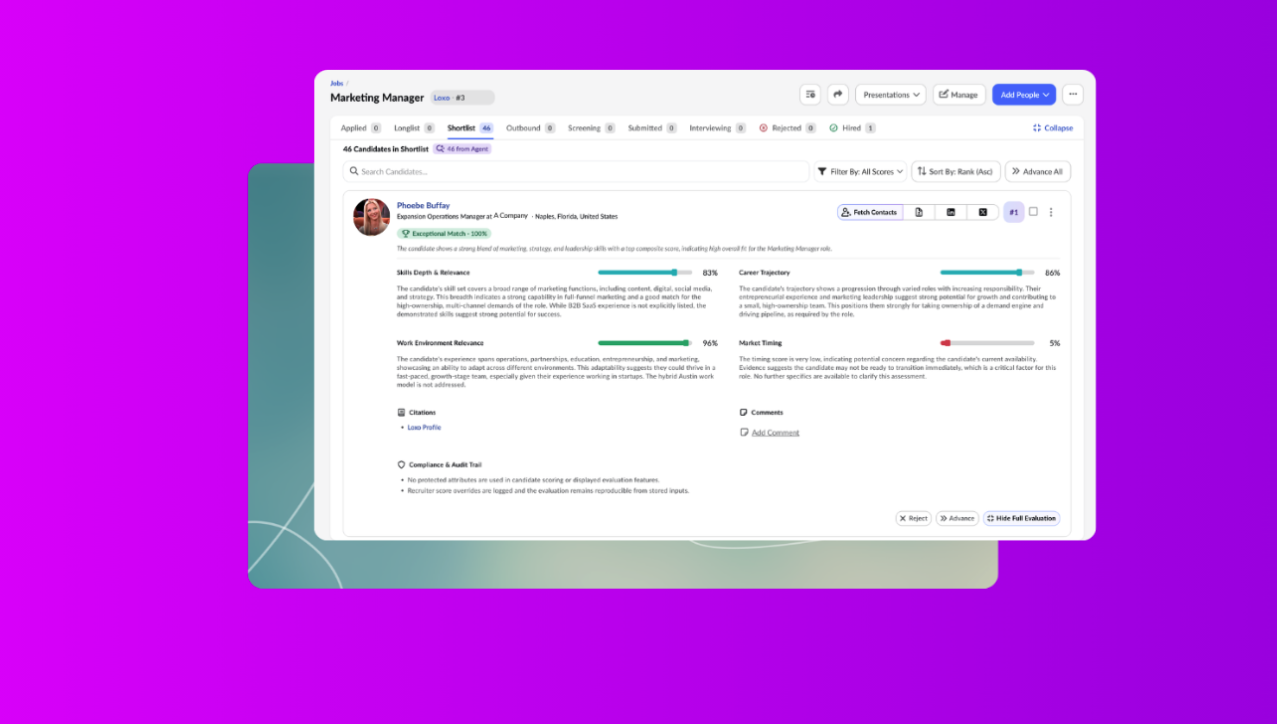
→ Enrichment in Loxo: Loxo includes built-in contact enrichment via the Loxo Contact Info Finding Agent. When you identify a candidate in your search results, you can surface their verified contact information directly within the platform — without switching to a separate enrichment tool, uploading a list, or waiting for a batch process to complete. The candidate's enriched data populates in the same record you'll use to manage their engagement.
Building and maintaining clean data
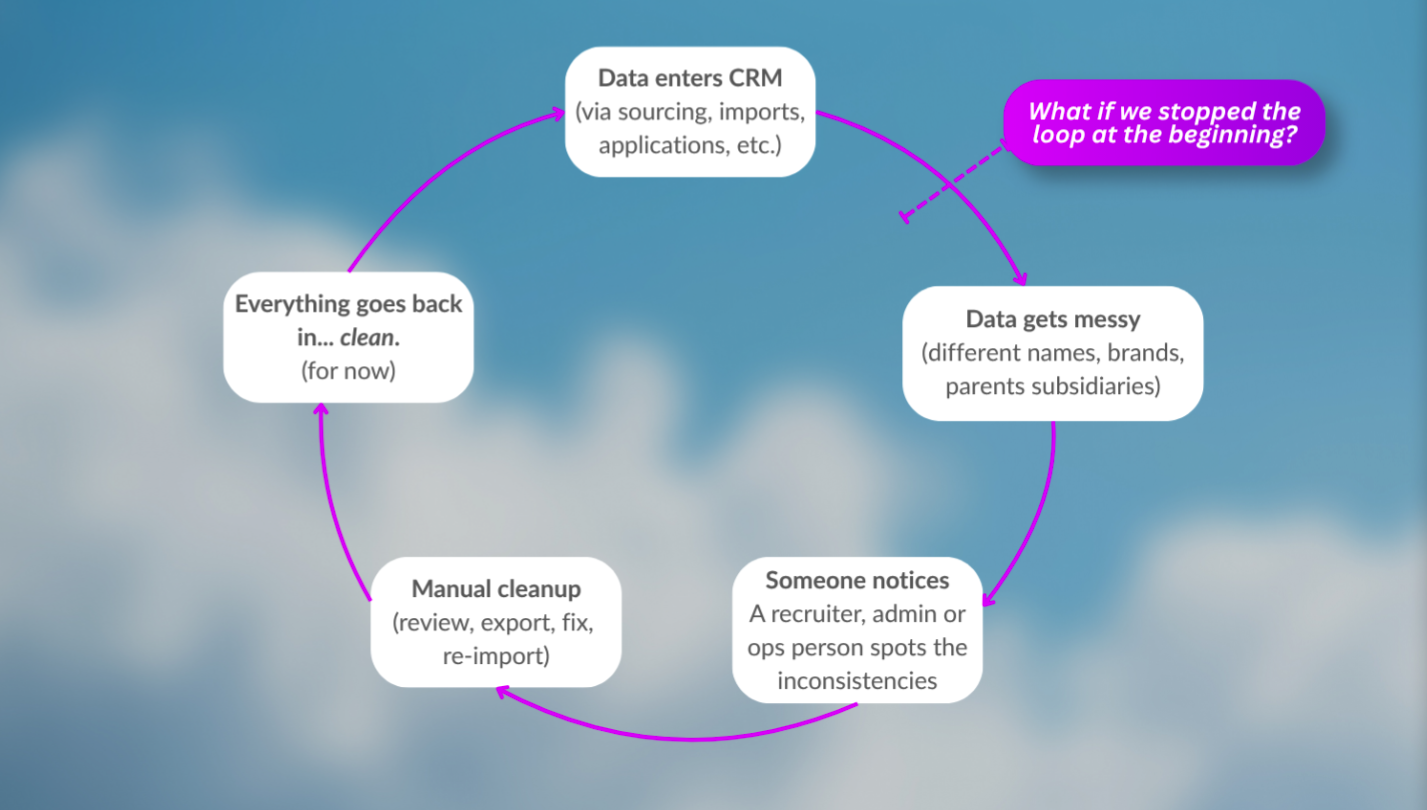
Enrichment solves the problem of finding contact information for new candidates. But there's an equally important challenge: the data you already have in your system.
Over time, databases accumulate stale records: candidates whose contact information is outdated because they've changed jobs, email addresses that no longer deliver, phone numbers that go to old employers. Working from stale data wastes time and damages your sender reputation.
Build a simple data hygiene habit into your sourcing process:
- Before adding a candidate from your internal database to an active outreach sequence, verify that their current employer and contact information are still accurate
- Use enrichment tools to refresh contact data on any internal candidate you haven't actively engaged in 12+ months
- Set a standard for how new candidate records are created — consistent field completion prevents the fragmentation that makes databases hard to search and use
- When a candidate changes jobs, update their record immediately — a job change is also a potential sourcing signal worth tracking
Clean data isn't glamorous work, but it's the foundation everything else is built on. Teams that invest in data hygiene consistently outperform teams that don't — because their databases actually surface useful candidates instead of records that are too incomplete to act on.
Step 4: Multi-channel outreach sequences that get replies
You've identified the right candidates and you have reliable contact information. Now comes the part that separates high-performing outbound sourcers from the rest: actually getting a response.
Passive candidates are not sitting around waiting for your message. They're busy, their inboxes are full, and they're perfectly comfortable where they are. Generic outreach will almost certainly get ignored. Outreach that's clearly researched, directly relevant, and easy to respond to is what gets replies.
The case for multi-channel sequences
A single touchpoint — one email, one direct message — is rarely enough to generate a response from a passive candidate who wasn't expecting to hear from you. Multi-channel, multi-touch outreach sequences significantly increase your reach rate by:
- Reaching candidates on the platform they happen to check on a given day
- Creating multiple low-friction opportunities to respond across a period of days
- Demonstrating genuine, persistent interest — which passive candidates read as a signal that this isn't a bulk email blast
The goal of a sequence is to be persistent without being pushy.
Sequence structure: a proven framework
Touch 1 — Email, Day 1
This is your primary outreach. Personalized, concise, low-friction CTA. The purpose is to start a conversation, not pitch a role.
Touch 2 — Connection request, Day 2
Send a connection request with a short, personalized note. References your email if you choose. Establishes a second touchpoint before they've had a chance to reply.
Touch 3 — Email follow-up, Day 4–5
Brief follow-up to your first email. Acknowledge they're busy. Add one new piece of value — a data point, an insight, a question. Don't repeat yourself.
Touch 4 — Direct message, Day 8–10
If connected, send a DM. If not yet connected, follow up on the connection request. Keep it short — 2–3 sentences maximum.
Touch 5 — Final email, Day 14
Ta-da! A graceful close. Acknowledge that the timing may not be right, invite them to reach out if that changes, and let them know you'll stay in touch. Leave the door open.
Writing the outreach message
Every message in your sequence should be built around four core elements.
1. The subject line: create curiosity, not pressure
Write subject lines that signal you've done your homework and create genuine curiosity — not pressure:
- Reference something specific to them: “Your work at [Company] + a question”
- Reference a transition or milestone: “[Company A] → [Company B] — that's an interesting move”
- Keep it under 50 characters for mobile readability
- A/B test subject lines across your sequences and track open rates to identify what resonates
2. The hook: validate their specific work
Open with evidence that this message is about them specifically — not a mail merge with their name at the top. Spend 3 minutes before you write finding something genuine and specific to reference: a project they led, a post they published, a product launch they were credited for, a career transition that shows what they value.
This investment is what separates a 2–3% response rate from a 25–35% response rate. It takes more time per message, but the arithmetic still favors personalization: 10 well-researched messages to strong-fit candidates will consistently outperform 100 generic blasts.
3. The value proposition: what's in it for them
Once you've earned their attention, give them a reason to keep reading. This does not mean copying and pasting a job description. It means framing what you're working on around their trajectory and interests.
Describe the problem they'd get to solve, not the requirements they'd need to meet. Reference the specific skills or experience you mentioned in your hook. Make it clear that you reached out to them specifically because of what they've built — not because they happen to match a keyword search.
→ Pro tip: Define what “good” looks like: "We're building out the demand generation function at [Company] — specifically, the infrastructure for account-based marketing at scale. Based on the ABM program you stood up at [Previous Company], I think the build phase here would be a genuinely interesting problem for you. I'd love to share more context and hear what you're focused on."
4. The CTA: remove barriers to a response
Your first message should be focused only on getting a response. Every element of your CTA should reduce the friction between the candidate and a “yes.”
- Never ask for a resume on first contact
- Don't ask for a 30-minute call — ask for 10 minutes or even a text exchange
- Give them an easy out: "Worth a brief exchange to see if there's any overlap — even if it's just to say this isn't the right fit?"
- Make replying feel like a low-stakes, professional interaction — not a commitment to a hiring process
→ Looking for more information on how to build a comprehensive passive recruitment outreach play? This in-depth playbook will tell you everything you need to know.
Timing and cadence
When you send matters almost as much as what you say. Tuesday and Thursday tend to outperform other weekdays for professional email open and reply rates. Within those days, morning windows (9–11 AM recipient time) and mid-afternoon windows (2–4 PM) perform best.
These are starting points, not rules. Test timing across your specific candidate segments. Technical candidates may respond differently than sales or operations professionals. Executives may be more reachable at non-peak hours. Track your data and adjust accordingly.
What strong outreach performance looks like
The industry benchmark for cold recruiter email is roughly a 22% open rate and 8–10% reply rate. Teams that implement personalized, multi-channel sequences with strong subject lines and relevant value propositions consistently outperform this benchmark significantly.
One documented example from Loxo's customer data: using AI-assisted outreach with personalized sequences, one team achieved a 66% open rate (3x the benchmark) and a 39% reply rate (4.5x the benchmark). Those numbers don't happen by accident — they're the result of combining the right targeting, the right personalization, and the right sequence structure.
So…what if they don't respond?
This may sound like fluff or like a pat on the back, but even a “No” is data. With that in mind, you want to optimize your outreach for responses — any response — because every response helps you calibrate.
→ We’ve got a podcast episode all about turning a “no” into an opportunity. You can listen to it here.
When it comes to analyzing performance:
- Low open rates typically signal a subject line problem — the message isn't getting opened, which means you need to optimize your subject line to make it either stand out more in the inbox or more relevant to the person you want to open it
- Opens without replies signal a message quality problem, because the message is being read but not acted on. Start to analyze whether your message is truly relevant to the recipient.
- Reconsider your timing: were you reaching out during a high-activity period at their company?
The reality is, some candidates simply aren't moveable right now — in this case, log them, set a follow-up reminder for 6–12 months, and move on.
Step 5: Nurture and measure — turning passive sourcing into repeatable pipeline
At its best, outbound sourcing is so much more than just a method for filling open roles — it's a continuous investment in relationships that build a sustainable pipeline before you need it.
The teams that build the most durable recruiting capability are the ones who build and sustain a network of warm relationships with high-caliber talent — so that sourcing becomes progressively faster and more effective over time.
The three-tier passive pipeline
The good and bad news? Not every candidate you source needs the same level of active engagement. Segmenting your pipeline by readiness to move is a good first step — as you can then match your outreach cadence accordingly.
Here’s an example of that segmentation:
Tier 1 — Active passive
Who they are: In the 2–4 year tenure window, showing passive readiness signals (company instability, recent leadership change, stalled trajectory), recent work anniversary.
Your outreach approach: Deploy active outreach now. Run the full sequence and prioritize for live roles.
Tier 2 — Warm passive
Who they are: Strong profile and fit, not yet in the readiness window, no active triggers.
Your outreach approach: Think periodic value-add touches — relevant market insights, industry reports, milestone acknowledgments, sent 1–2 times per quarter. No ask, just relationship maintenance.
Tier 3 — Cold pipeline
Who they are: Strong long-term potential; no current signals; may be too junior or too early in tenure, but are strong candidates overall.
Your outreach approach: Broad content nurturing — newsletter, relevant articles, social media engagement. Review this list quarterly for new readiness signals.
Reading passive readiness signals
This brings up an important point around how to segment candidates — like what variables are positive indicators, which ones indicate you should probably not put your eggs in that basket, and beyond. Proactive sourcing gets infinitely more efficient when you learn to read signals that indicate a candidate may be more open to a conversation — even if they haven't said so and aren't actively looking.
The 2–4 year tenure window
Research on employee engagement consistently shows that the desire for upward mobility or compensation correction tends to peak around years three and four in a role — even when the employee isn't actively searching. This is your highest-yield targeting window for proactive outreach.
What to do: You can use your ATS filters to surface candidates approaching or within this tenure range.
The stalled trajectory signal
A candidate who has been at the same company for four or more years with no title change, no visible scope expansion, and no public evidence of advancement is a strong candidate for an upgrade conversation.
What to do: Cross-reference company growth signals: if the organization has been flat or contracting, the candidate may be experiencing the ceiling effect that makes professionals receptive to thinking about what's next.
Macro vulnerability signals
Certain company-level events create environments where high-performing employees become significantly more open to external conversations:
- C-suite leadership turnover — new executives change strategy, culture, and team composition; the existing team gets anxious
- Return-to-office mandates — companies announcing RTO after extended remote work periods tend to see meaningful voluntary churn among top performers who have options
- M&A activity — post-acquisition uncertainty, role redundancy, and equity uncertainty push talent to reassess their situation
- Funding stress — companies 18+ months post-funding that have not announced a follow-on round; teams operating on uncertain runway
- Layoff survivor fatigue — the 60–90 day window after a significant layoff announcement often sees secondary voluntary departures from employees who remain but reassess
What to do: Don’t worry — you don't need to become a full-time industry analyst; there are plenty of tools that make staying on top of changes like these easy. Layoffs.fyi maintains a running list of recent layoff announcements. Google Alerts for target company names takes five minutes to set up. Crunchbase tracks funding activity. A 15-minute weekly scan across these sources can meaningfully improve the quality of your timing on outreach.
Value-add nurture: staying relevant without asking for anything
The most sustainable passive pipeline is built on relationships, not transactions. The candidates who receive genuine value from you over time — not just outreach when you have a role — become your best source of referrals and your most responsive contacts when they're finally ready to move.
The best news? Effective value-add nurturing doesn't require a lot of time. The key is relevance (there’s that magic word again). Every touch should feel like something you sent specifically because you thought of them.
- Share a relevant market insight, salary benchmark, or industry data point: "Saw this comp data for [their function] and thought it might be useful"
- Acknowledge professional milestones: a promotion, a company news mention, a published piece, a speaking engagement
- Make warm introductions between people in your network who would benefit from knowing each other — this positions you as a connector and generates genuine reciprocity
- Share a relevant observation even when you're not pitching: "Noticing a surge in [their specialty] hiring right now — happy to share what I'm seeing if useful." No ask, just signal that you're paying attention to their market
Want more on this topic? We’ve got a great, in-depth guide all about relevance vs. personalization.
Repeat after me: Consistency over intensity. Two or three thoughtful touches per quarter with a Tier 2 candidate is waaaay more effective than radio silence for six months followed by a pitch-slap when a role opens.
Measuring outbound sourcing performance
Visibility is everything — because you can't improve what you don't measure. For in-house teams building an outbound motion for the first time, these are the metrics worth tracking from day one:
Activity metrics (inputs)
- Candidates sourced per week / per recruiter
- Outreach sequences initiated
- Messages sent per channel (email, DM, phone)
Engagement metrics (signal quality)
- Email open rate by sequence / by recruiter / by subject line variant
- Reply rate — overall and broken down by touch number
- Connection acceptance rate
- Conversion rate from initial contact to phone screen
Pipeline metrics (outcomes)
- Sourced candidates advanced to interview stage
- Sourced hires as a percentage of total hires
- Time-to-fill for roles with active sourcing vs. inbound-only roles
- Quality-of-hire indicators for sourced vs. inbound hires (where measurable)
Track these metrics weekly at both the individual recruiter level and monthly at the team level (if relevant). The goal isn't to hit a specific number in isolation — it's to build a baseline, understand what your current performance looks like, and then drive systematic improvement over time.
Common pitfalls when shifting a team from inbound to outbound
As you can see from the above guide, building an outbound sourcing motion isn't technically complex — but the organizational and behavioral shift it requires is real, and shouldn’t be underestimated. Below, we’ve mapped out a few common failure points — because if you know them in advance, you can avoid them as you seek to implement this process for yourself and your team.
Pitfall 1: Treating outbound as a one-time project
The most common mistake in-house teams make when launching outbound sourcing is treating it as a burst of activity tied to a specific hard-to-fill role, rather than a continuous operational capability. The most important thing to remember is that outbound sourcing is an investment — and one that produces compounding returns over time. The relationships you build, the database you populate, and the search strategies you develop in the present moment become significantly more valuable 12 months from now. But teams that start and stop don't see those returns. Build outbound sourcing into your regular workflow from the start — set weekly sourcing targets, assign ownership, and make it a standing agenda item in team meetings. That consistency is where you’re really going to see the investment pay off.
Pitfall 2: Skipping the ever-crucial search definition step
The efficiency gains of a well-structured search are substantial. Teams that skip the sourcing brief and jump straight to browsing databases spend significantly more time reviewing low-fit candidates and end up with a shortlist that's hard to defend to hiring managers. The upfront investment in defining the search precisely pays for itself — usually within the first search. This is all part of the goal to shift your focus — and your perception internally — from “recruiter” to true “talent advisor.”
Pitfall 3: Defaulting to a single channel
Teams new to outbound often default to one channel — usually email or DM — and then wonder why response rates are underwhelming. Multi-channel sequences outperform single-channel outreach meaningfully, in basically every use case. The combination of email and DM is the most accessible starting point for most in-house teams — but if you can find a way to incorporate text, too, it can be a game-changer in certain roles.
Pitfall 4: Sending personalization at scale…without actually personalizing
The emergence of AI-assisted outreach tools has created a new failure mode: messages that look personalized (like, with a merge field…or twenty) but feel like template outputs. Candidates who receive a lot of recruiter outreach can identify AI-generated hooks almost immediately. Real personalization requires actual research — a specific insight about their work, a genuine connection to why you reached out to them and not someone else. Tools can help with scale, but the research behind each message still requires human judgment. That’s your competitive advantage, and your differentiator — use it wisely, and use it often!
Pitfall 5: Not measuring engagement data
Remember when we said visibility is everything? Without tracking open rates and reply rates at the message and sequence level, you have no way to distinguish what's working from what's not. Teams that don't measure spend months running sequences that could be significantly improved with minor adjustments to subject lines or hooks. Set up tracking before you launch your first sequence, not after. If you use a platform like Loxo, reporting is built directly into the platform, so you can always dig in to see what’s working, what isn’t, and — arguably most importantly — why.
Pitfall 6: Neglecting the internal database
Every good recruiter knows that your relationships are everything — but if you’re not leveraging them, you’re not getting as much out of them as you could be. Many TA teams invest in external sourcing tools while leaving their existing database wildly underutilized. Every candidate who has ever been in your process — applied, interviewed, been referred, or simply expressed interest — represents a warm relationship you've already begun building. Regularly mining this pool for candidates who fit current or upcoming roles should be a standard practice, not an occasional fallback.
Important note: Data is only as good as it is accurate and up-to-date. Loxo’s Self-Updating CRM Agent keeps your data fresh.
Pitfall 7: Expecting immediate results
Like we said: Outbound sourcing is, in many ways, a long game. It produces a better quality pipeline than inbound, but it operates on a longer timeline for the first 60–90 days while you're building your pool and refining your sequences. Set expectations with leadership accordingly. The metrics to track early are activity and engagement (sequences launched, open rates, reply rates) — not just hires, which lag by definition. Teams that get impatient and abandon the motion before it matures never capture the compounding returns that make outbound sourcing so valuable.
Putting it all together
Building an outbound sourcing motion from scratch is a meaningful operational investment — but it requires a shift in how your team thinks about sourcing, new skills in search construction and outreach, discipline in data hygiene, and the patience to let compounding returns develop over time.
The outcome — a pipeline that isn't constrained by who's actively looking — is a genuine competitive advantage, and well worth the effort.
Let’s review the framework at a high level:
- Step 1 — Define the search. Build a sourcing brief before you open any tool. Map title variants, target companies, and the difference between must-haves and preferences. Build and save a Boolean or NLS query.
- Step 2 — Source from both pools. Check your internal database first — prior candidates, past applicants, and existing relationships are your warmest leads. Supplement with external databases and prioritize your shortlist before moving to outreach.
- Step 3 — Enrich contacts. Don't let data quality be the bottleneck between identifying the right candidate and reaching them. Verify contact information before launching sequences and maintain clean, current records as a standing practice.
- Step 4 — Build outreach sequences that earn replies. Multi-channel sequences that combine genuine personalization with relevant value propositions consistently outperform single-touch outreach. Make your first ask easy to say yes to.
- Step 5 — Nurture and measure. Segment your pipeline by readiness tier, maintain warm relationships through value-add touches, and track engagement and pipeline metrics consistently. The teams that measure improve the fastest.
Want to explore how this could work for your business? Start small if you need to. Run one well-defined outbound search before you try to overhaul your entire sourcing workflow. Build the muscle, refine the process, and expand from there.
The 70% of the talent market that isn't applying to your jobs is far from unreachable — they just need someone to go find them. If you’re willing to invest in the process, that someone could easily be you.
Want to learn more about how Loxo helps in-house TA teams build and scale an outbound sourcing motion?
<script type="application/ld+json">
{
  "@context": "https://schema.org",
  "@type": "BlogPosting",
  "mainEntityOfPage": {
    "@type": "WebPage",
    "@id": "https://www.loxo.co/blog/the-in-house-teams-guide-to-building-an-outbound-sourcing-motion"
  },
  "headline": "The Outbound Sourcing Playbook for In-House TA Teams",
  "description": "A step-by-step playbook for TA managers building an outbound sourcing capability: defining the search, sourcing from internal and external databases, contact enrichment, multi-channel outreach sequences, and nurturing a passive candidate pipeline.",
  "image": "https://www.loxo.co/",
  "author": {
    "@type": "Person",
    "name": "Lex Winship"
  },
  "publisher": {
    "@type": "Organization",
    "name": "Loxo",
    "url": "https://www.loxo.co",
    "logo": {
      "@type": "ImageObject",
      "url": "https://www.loxo.co/"
    }
  },
  "datePublished": "2026-07-02",
  "dateModified": "2026-07-02",
  "keywords": "outbound sourcing, passive candidates, talent acquisition, candidate sourcing, recruiting outreach, sourcing strategy, in-house recruiting, talent intelligence",
  "inLanguage": "en-US",
  "isPartOf": {
    "@type": "Blog",
    "name": "Loxo Blog",
    "url": "https://www.loxo.co/blog"
  }
}
</script>