Most recruiters have heard all three words used interchangeably in sales calls this year, which is part of why the promises stopped meaning much.
Here's what each one actually is, where Loxo uses each, and what changes for a recruiter's day depending on which one they're working with.
AI: the model underneath everything
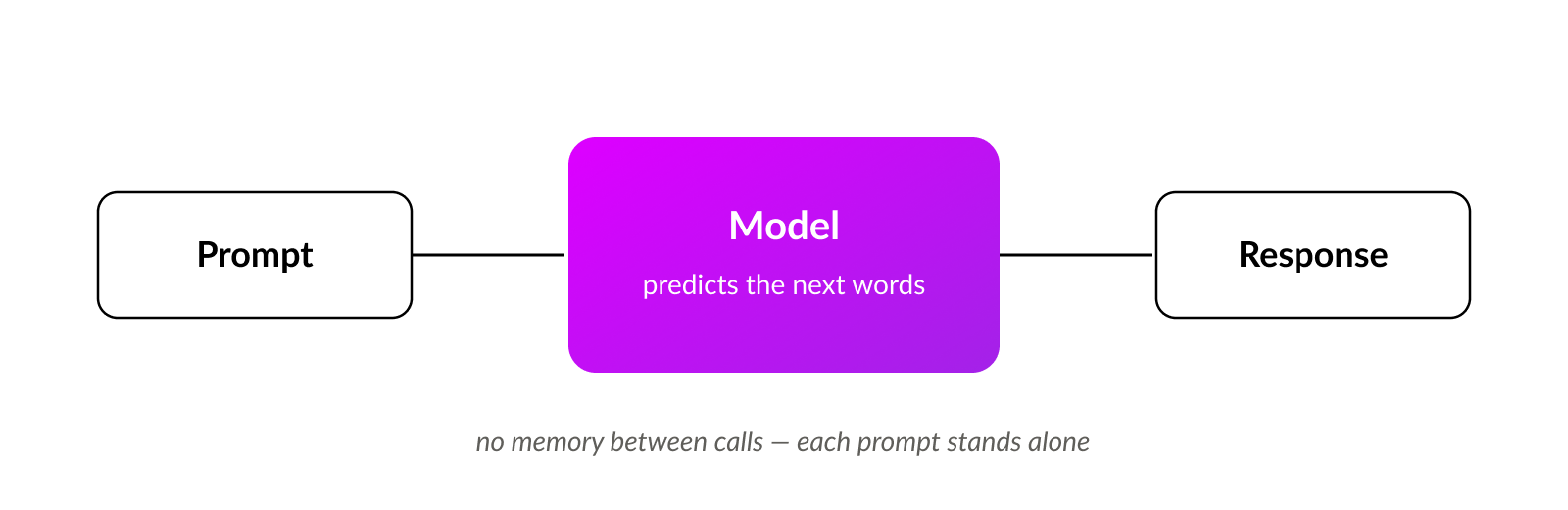
AI, in the form recruiters encounter it, is often a Large Language Model (LLM) like ChatGPT. LLMs are prediction models. By analyzing vast pools of information, LLMs learn the statistical relationships between words and phrases, and then generate text or make a prediction from a prompt.
Give an LLM a job title and a few requirements, and it drafts a job description. Give it a résumé and a role, and it writes a summary of the match. Ask it a question about a candidate in your database, and it answers using whatever context it has been given. That's the whole transaction: a prompt goes in, a response comes out, and the model has no memory of the last ten prompts unless something outside the model is keeping track.
Loxo AI Chat is a great example of this kind of AI within Loxo. It pulls your favorite LLM or AI assistant directly into Loxo. Ask it something about a candidate, a search, or your pipeline, and it answers from your Loxo data. It's a front door into the platform, useful the way a knowledgeable colleague answering a quick question is useful. It doesn't decide anything. After typing a question into it, a recruiter gets an answer to exactly that question, once, and then the conversation ends unless the recruiter asks something else.
For recruiters evaluating vendor claims, it’s important to understand: a chat box bolted onto an ATS is a weekend project for most engineering teams right now. If a tool's entire "AI" story is a chat interface that answers questions about your own data, that's a real capability — but it's a small one.
AI agents: software trained to do a specific job
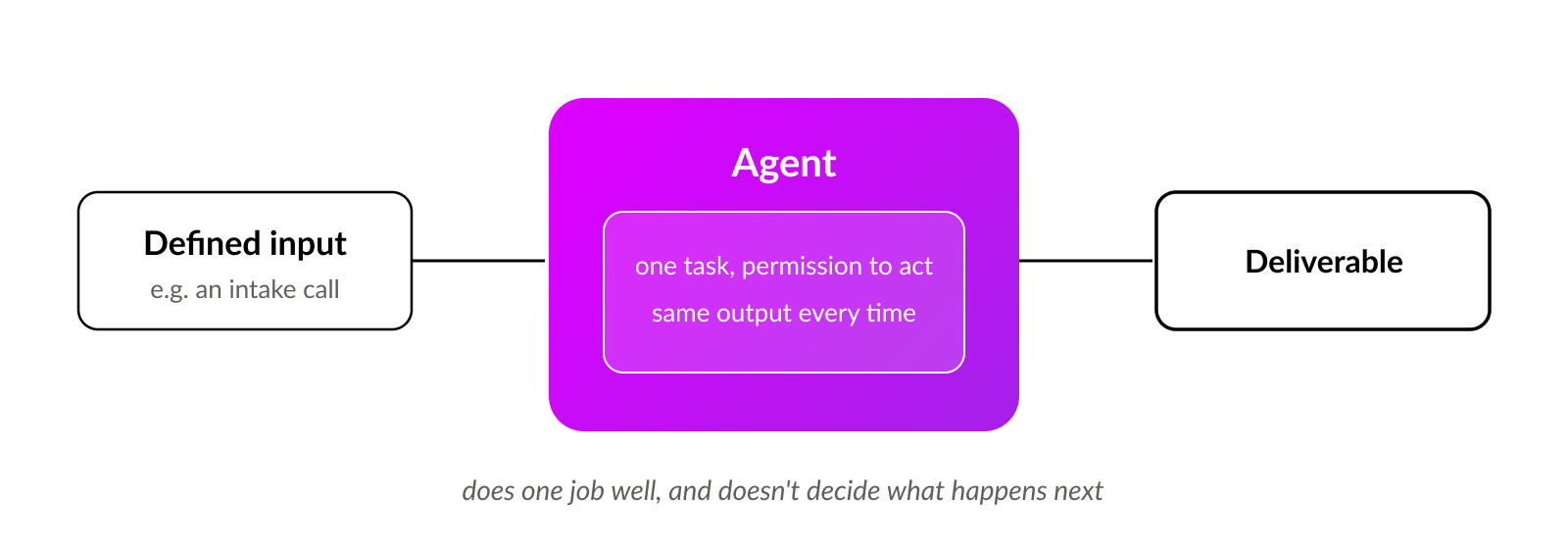
An agent takes that same underlying model and gives it a specific task, a defined set of inputs, and permission to act, not just answer.
For example, Loxo's Job Description & Skills DNA Agent takes an intake conversation and turns it into structured, weighted requirements, then builds a job description from those requirements.
It's not answering a question. It's producing a deliverable a recruiter would otherwise have written by hand, and it's producing the same deliverable every time from the same inputs, which is a different kind of reliability than a one-off chat response.
The Intake Agent works the same way at the front of a search: structuring a hiring conversation into requirements a sourcing strategy can actually be built on.
A Longlist Agent reads across the addressable talent pool and a firm's own database, then returns candidates who match.
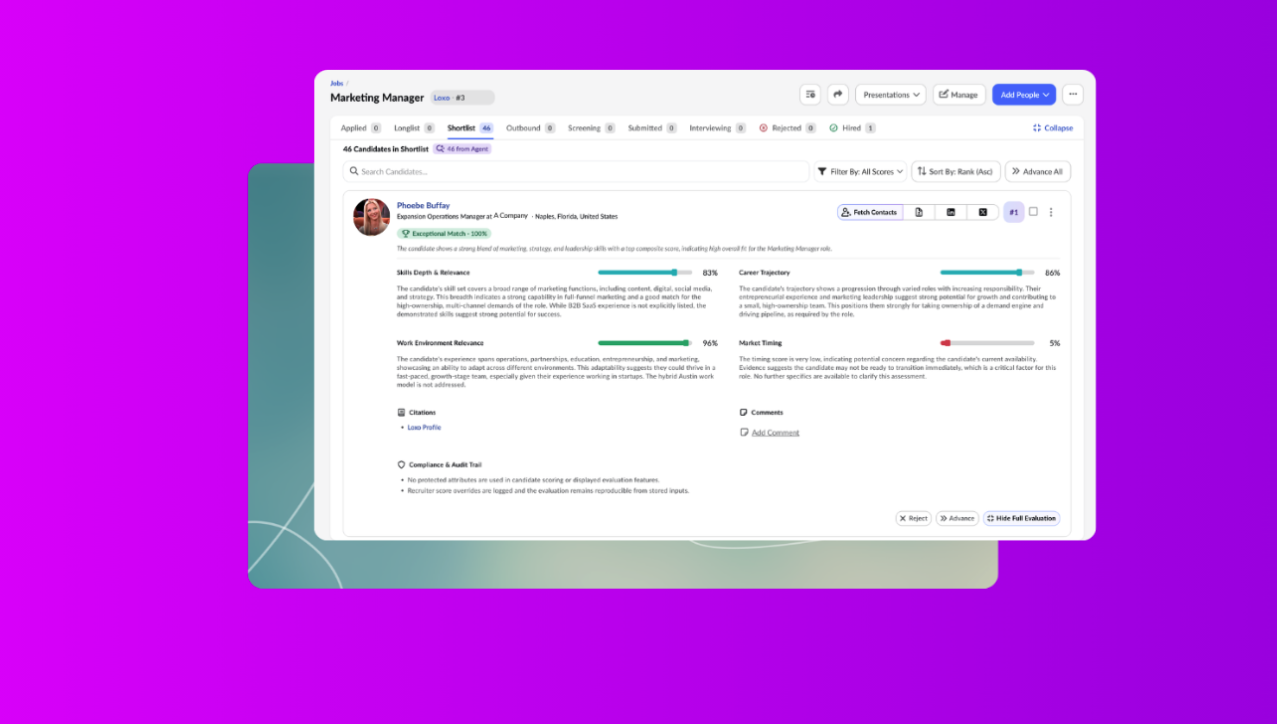
A Shortlist Agent scores and ranks those candidates against the intake requirements, evaluating each one across several dimensions with evidence attached rather than a single fit score.
Data Hygiene, Deduplication, and Self-Updating CRM agents run in the background keeping a database clean and current, a job that used to fall to whoever on the team had the patience for it.
Each of those agents does one job well and stops. The Longlist Agent doesn't decide who gets contacted. The Shortlist Agent doesn't reach out to anyone. A recruiter working with individual agents picks up a tool for a specific task the way they'd delegate one piece of a search to a specialist on their team, and the rest of the search still runs the way it always has.
What matters for a recruiter here: an agent is only as good as what it can see. An agent with access to a firm's full database, activity history, and a large talent graph will outsource work meaningfully. An agent bolted onto a shallow dataset returns thin, generic results no matter how the interface looks.
Before trusting an agent's output on a search that matters, it's worth asking what data that agent is actually drawing from. Is it drawing from your firm's own history or is it just a generic model guessing from a job title?
Agentic workflows: agents hand off work to each other, ending at a human
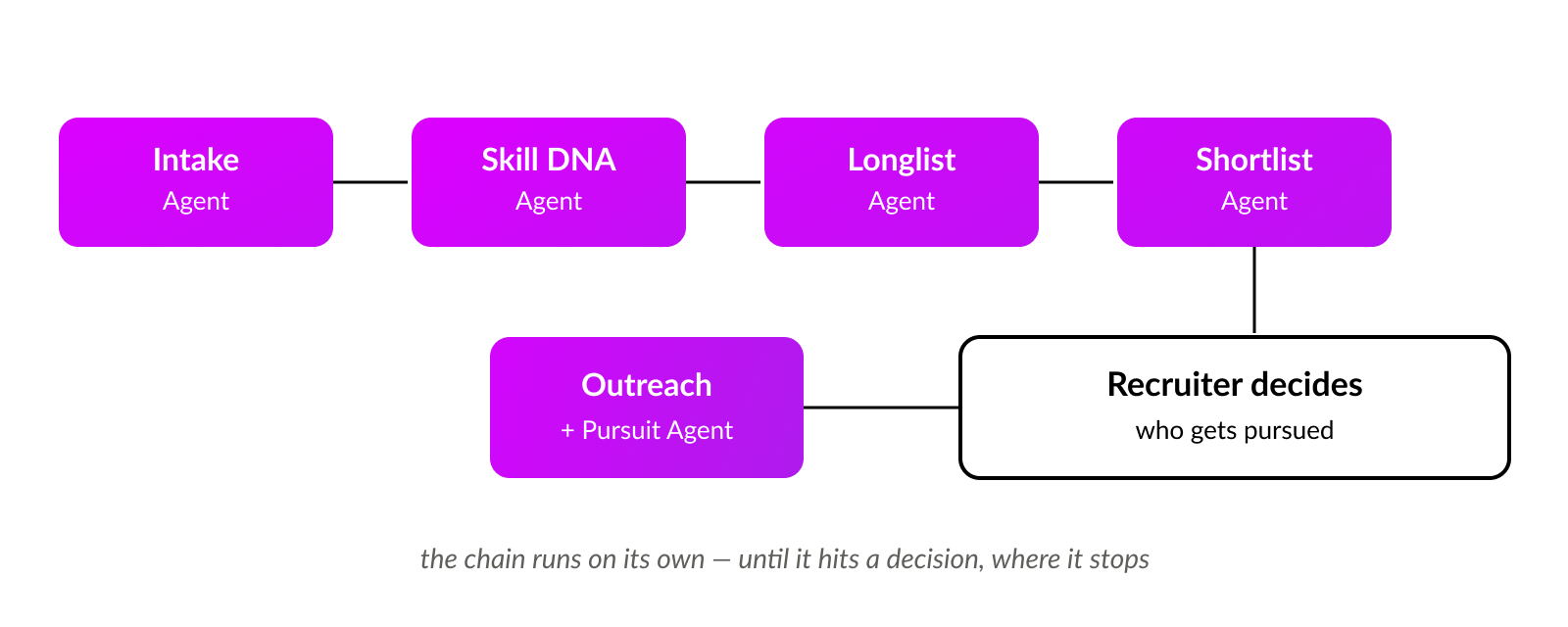
An agentic workflow is what happens when several of those agents run in sequence. Each agent's output becomes the next one's input, without a person clicking "next" between steps.
This is where most of the confusion in the market lives, because plenty of software calls a single agent "agentic," when what actually defines the term is the handoff chain.
In Loxo's Full Agentic Mode, a recruiter approves a search assignment and the workflow runs on its own from there.
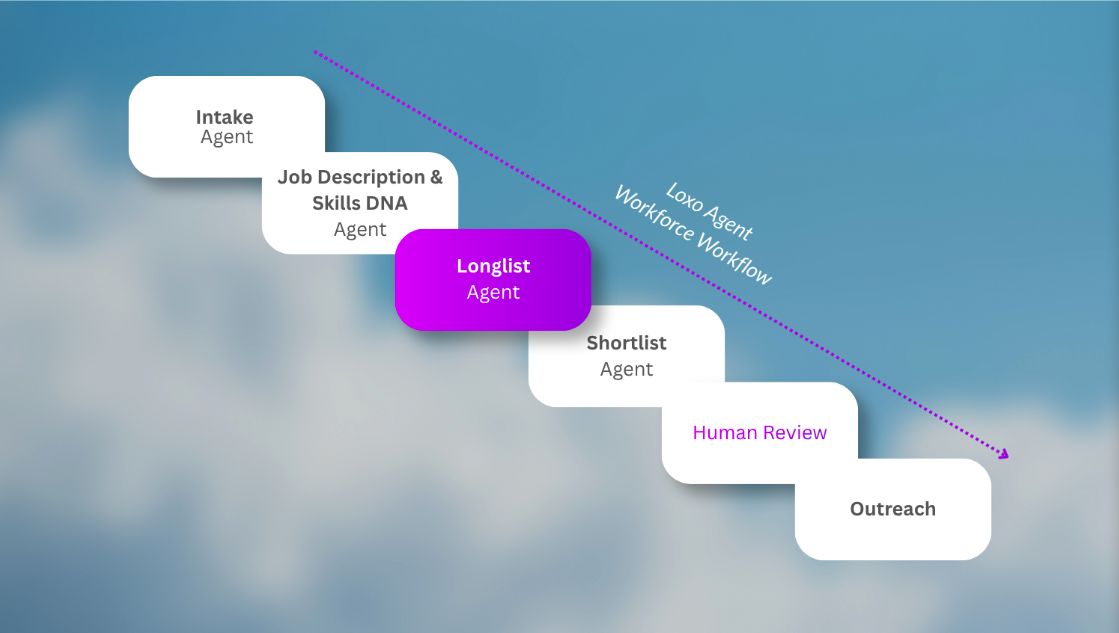
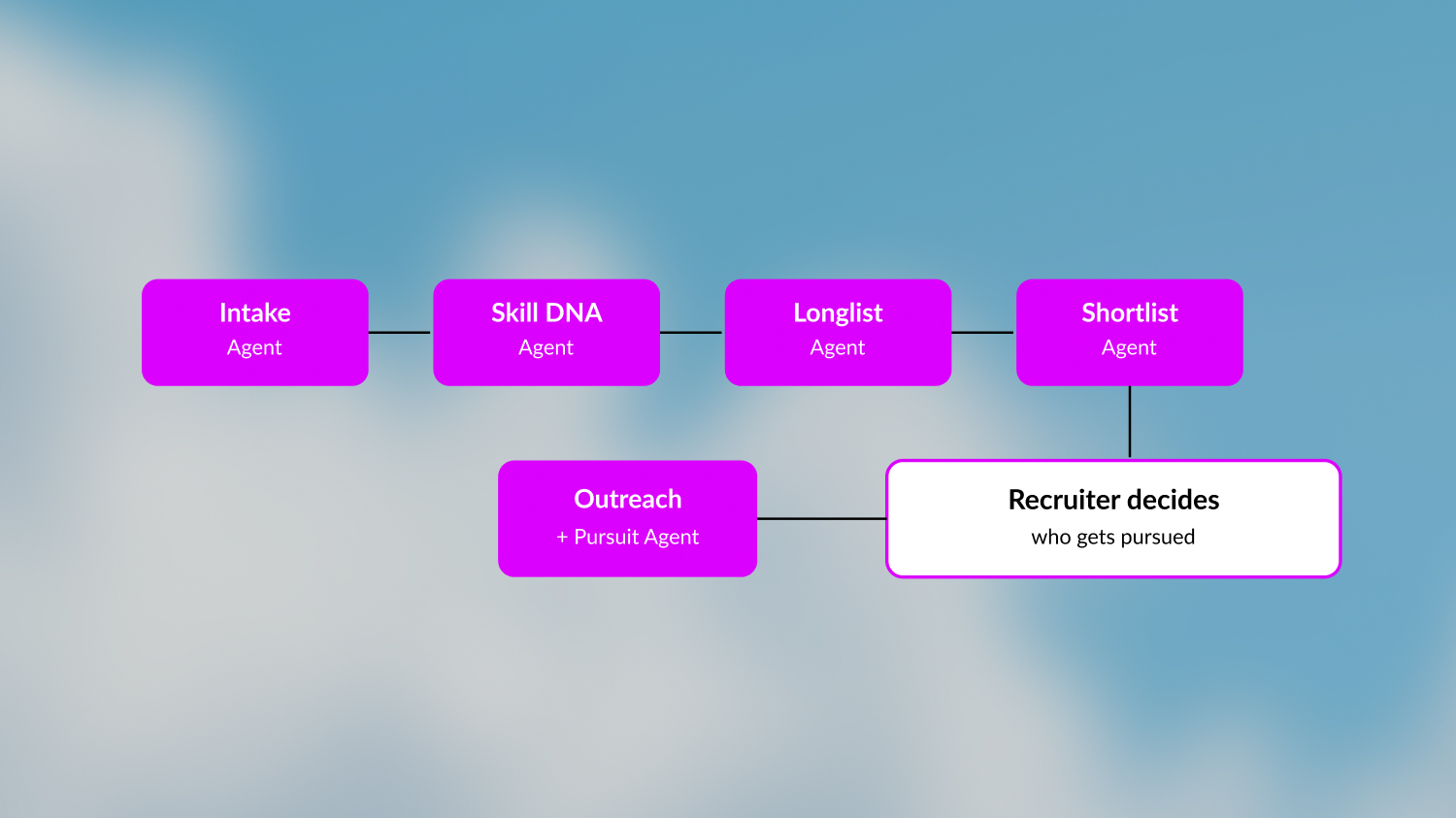
Intake becomes Skill DNA. Skill DNA becomes a job description and a sourcing strategy. The sourcing strategy drives the Longlist Agent across the entire addressable pool, including hundreds of millions of professionals plus the firm's own database, pulling as many as ten thousand candidates into consideration. Those candidates get scored and ranked against the original intake requirements. What comes out the other end is an ordered shortlist, each candidate analyzed across seven dimensions with evidence behind the ranking. All of that happens in minutes, not weeks, without a recruiter touching a single step in between.
Then the workflow stops. Not because it ran out of steps, but because the next step is a decision, and Loxo draws a hard line at decisions.
A recruiter reviews the ranked shortlist and picks who gets pursued. Only then does the Outreach + Pursuit Agent take over, running personalized sequences and automatic follow-up on exactly the people that recruiter chose, and no one else.
Nobody gets contacted, advanced, or passed over by a chain of agents acting without a person in the loop. That boundary isn't a policy someone wrote down. It's built into where the workflow physically stops.
The Agent Impact Center sits alongside all of this, showing what each agent did, how long it took, and what came out of it — so the workflow isn't a black box a recruiter has to take on faith.
What this means for a recruiter's actual week: the labor that used to eat the front half of a search — reading the market, building a longlist, scoring candidates against requirements — now happens before lunch instead of over two weeks.
The part of the job that made recruiting recruiting: deciding which human is right for a role and then persuading them to take it, is what's left standing. And it's now most of what the day looks like.
That's a real shift in how time gets spent on a desk, not a cosmetic one.
If you’re evaluating recruitment tech: It also means the right question to ask about any "agentic" claim from a vendor is where the chain actually stops. Does it stop at a ranked list a human reviews, or does it keep going through outreach and follow-up without anyone deciding who gets contacted?
A workflow that runs data collection and analysis on its own is doing real work. A workflow that also decides who a candidate hears from without a person choosing that is a different and much riskier thing. It's worth knowing which type of agentic workflow is sitting in front of a recruiter before a search assignment gets handed to it.
Putting it together on a real search
A recruiter using Loxo AI Chat is asking a question and getting an answer. A recruiter using the Longlist Agent or Shortlist Agent by itself is delegating one piece of a search while running the rest by hand, exactly as they always have. A recruiter running Full Agentic Mode is handing the market-mapping half of a search to a workforce and picking the moment back up at the shortlist, when they use their expertise to decide who gets pursued and why.
None of those three is a lesser version of the others; they're different tools for different moments in a search. Knowing which one a recruiter is actually holding:
- A model answering a question
- An agent doing a job
- A workflow running a chain of jobs to a decision point
...is what separates a firm that understands its own stack from one repeating a vendor's slide deck.