


Why passive recruiting matters more than ever
Let’s start with a fact you’re probably already rubbing up against every single day: the recruiting landscape in 2026 has undergone a fundamental shift. The post-pandemic hiring surge is over, AI uncertainty has taken over, and the future feels shakier than ever before. We are in what SHRM has taken to calling a “low-hire, low-fire” environment — fewer open roles, more competition for every quality candidate, and a passive talent pool that is staying put longer than ever.
Here is the core reality: the majority of the best candidates in any market are not applying to your jobs. They are employed, engaged enough to stay put, and only moveable under the right conditions — which means the recruiter who finds them first and pitches them best wins.

The 2026 market context
Understanding the macro environment helps you frame your pitch to passive candidates and sharpen your targeting strategy:
- Job openings sit at 6.9 million (BLS JOLTS, Feb 2026) — down nearly 900,000 from a year prior. Roles are harder to fill, not easier.
- The quit rate has held steady at 3.2 million per month — passive candidates are not moving freely on their own. They need to be activated.
- Only 20% of LinkedIn job listings are remote or hybrid, yet those listings attract 60% of all applications — a signal that quality talent has strong preferences your clients must navigate.
- Employer skills demands are shifting fast— 39% of key job skills are expected to change by 2030, which means hiring for adaptability and trajectory matters as much as current credentials.
- Job boards deliver 49% of applications but only 24.6% of hires. Sourced and referred candidates dramatically outperform inbound on conversion.
→ The competitive reality
If a top candidate does apply to your role, the chances are they have also applied to many others. Which means you instantly find yourself in a bidding war (and we all know what a joy those can be). Proactive sourcing lets you get there first — before the competition even knows the candidate exists.
The active applicant blind spot
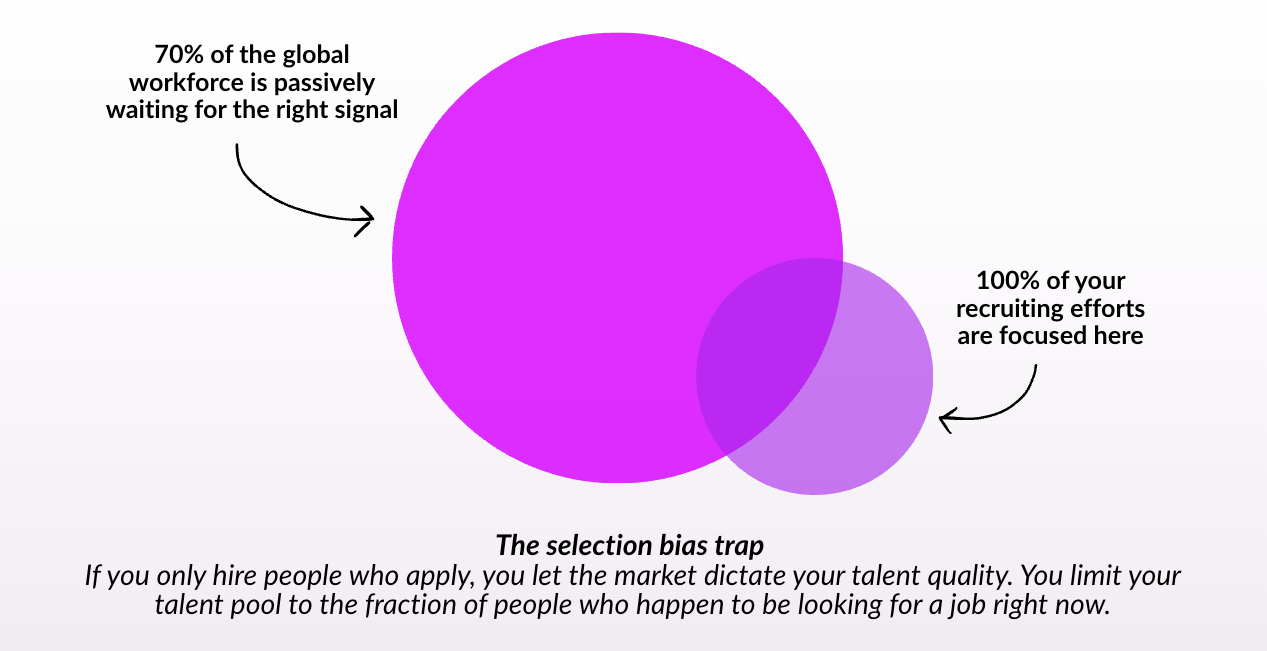
When you only source from your inbox, you are not accessing the talent market — you are accessing the fraction of the talent market that happens to be looking right now. This creates several compounding problems:
- Selection bias trap: You let the market dictate your talent quality rather than defining it yourself.
- The black hole problem: Elite candidates refuse to submit their resume into an anonymous ATS where they risk being filtered out by an algorithm. Top performers know their worth and are often not willing to take that risk with their very precious time.
- The busy performer problem: Your best potential hire is buried in execution right now. They are not browsing job boards — they are closing deals, shipping product, and leading teams.
- The inbound tax: Just like top candidates’ time is precious, so is yours. Sorting unqualified inbound resumes costs hours. That same time could be used for surgical outreach to five perfect-fit candidates.
→ The mindset shift
Stop being a reactive gatekeeper sorting who wants the role, and become a proactive talent investor going after exactly the talent your clients need.
Signals that a passive candidate is ready for a move
Here’s the key: effective passive sourcing is not random. The best recruiters read invisible signals that tell them when someone is psychologically primed for a change — even if that person hasn’t admitted it to themselves yet.
So, basically: You could tell people at parties you’re something akin to a mind-reader or a mentalist, which is pretty cool.
Here's a few of those signals, and how to spot them:
The 2–4 year golden window
Industry data consistently shows that employee engagement and learning curves peak around 18–24 months in a role. By years three and four, the desire for upward mobility or compensation correction peaks — even if the employee is not actively looking.
→ Tactical application
Use your ATS or sourcing platform filters to target candidates in the 24–48 month current-tenure sweet spot. This is likely to be your highest-yield passive pool.
Candidates you’ve engaged previously
Many ATS and Talent Intelligence Platforms allow you to surface candidates you submitted or had in process 24–48 months ago. These candidates are absolute gold, because:
- They were qualified then — which means they’re almost certainly still strong
- You have an existing relationship and warm rapport to leverage (it doesn’t get much better than that, truly)
- They’ve had 2 more years of experience since you last spoke — which means they may now qualify for a level above where they previously interviewed
The ghost promotion signal
One of the most powerful indicators of passive readiness is what we call a ghost promotion (it sounds spookier than it actually is) — a candidate who has been at a company for 4+ years with no title change, no visible scope expansion, and no public evidence of advancement. These individuals are prime candidates for an upgrade conversation.
→ Tactical application
- Search for candidates whose titles have not changed in 3+ years despite long tenure
- Cross-reference company growth signals — if the company has been stagnant or shrinking, the candidate may be feeling the ceiling
- Look for candidates at companies where leadership has turned over above them — a new boss is often the trigger that makes good people reassess
Macro signals & market vulnerability
When it comes to signals, you can look beyond the individual candidates themselves to the structural forces that affect where they work. Companies in certain situations create pools of psychologically ready candidates. Think:
Leadership & strategy shakeups
- C-suite turnover: New executives almost always change strategy, culture, and team composition. The existing team gets anxious.
- Return-to-Office mandates: Companies announcing RTO after years of remote work trigger significant voluntary churn among top performers who have options.
- M&A activity: Post-acquisition uncertainty creates one of the highest-yield passive candidate environments in recruiting. Role redundancy, cultural clash, and equity uncertainty all push talent to consider exits.
- PE buyouts and restructuring: Financial sponsors typically prioritize cost reduction post-acquisition, creating widespread anxiety in the acquired company's talent base. Often, innovation stalls and the job doesn’t feel as fulfilling anymore.
Funding & financial stress signals
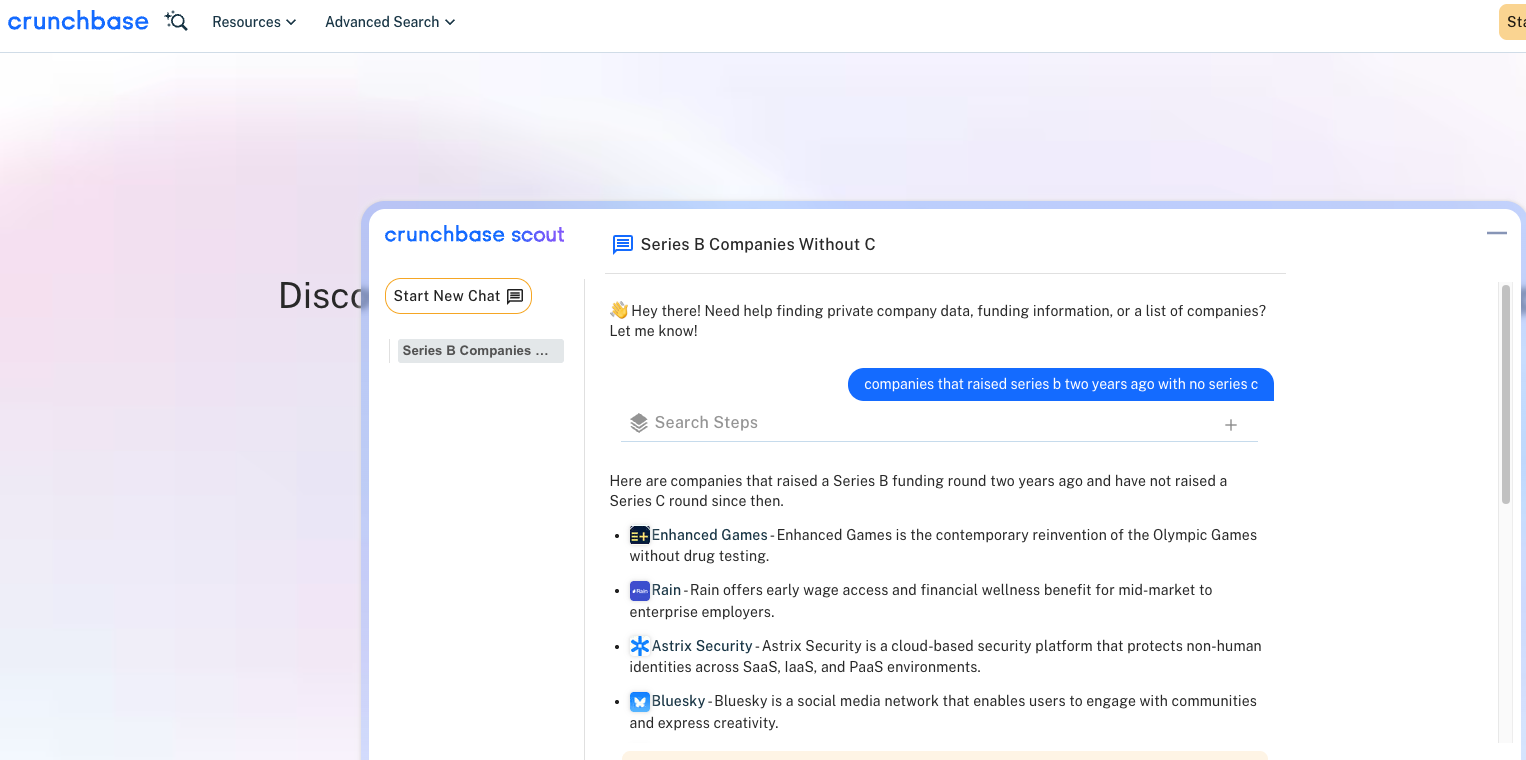
- Target companies 18 months post-Series B that have not announced a Series C. Burn rates are high, runway is uncertain, and equity value is questionable.
- Look for companies that raised in the 2021–2022 peak valuation environment. Their paper equity is likely underwater, reducing a key retention tool.
- Monitor for public reports of layoffs, hiring freezes, or restructuring — the survivors often become passive candidates within 60–90 days.
→ Tactical application:
As a busy recruiter, you surely don’t have time to immerse yourself in the world of layoffs and venture capitalism. So here are some quick tips to help you stay up-to-date without taking too much time from your day-to-day responsibilities.
- Layoffs.fyi keeps a running list of recent layoff announcements. Learn about recent shakeups with a quick glance.
- Crunchbase offers an AI agent that you can ask financial questions about companies in natural language.
- Set up Google Alerts for relevant news articles in your niche.
- Look for relevant newsletters from companies like TechCrunch to get updates right in your inbox.
Human intelligence is your biggest asset
If you’re reading this playbook, we’re going to assume you’re very good at what you do (take that compliment to the bank).
As a top 10% recruiter, some of the best passive sourcing triggers come from conversations you are already having. To become a top 1% recruiter? Train yourself to extract talent intelligence from every interaction.
The post-placement audit
When you check in on a recently placed candidate, ask the high-signal question:
"Who was the sharpest person on your old team that the company couldn't afford to lose?"
This single question can populate your pipeline with pre-vetted, high-caliber candidates — all with a warm implied referral. Ooh la la.
The backchannel business development play
When conducting a reference check for a client, don’t simply end the call when business is done. The reference — often a senior leader! — has already demonstrated good judgment by employing your placed candidate. Not to mention: their defensive walls are down. Ideally, they respect your taste in talent because you are placing someone they believed in.
→ Tactical application
- Introduce yourself properly at the end of the reference call
- Note the connection: you are placing someone they developed and trusted
- Ask a light exploratory question about their own team needs or career trajectory
- Add them to your long-term network — they are both a future client and a future candidate
The “give to get” play
Sometimes, building those connections that pay off in helpful news or referrals is as simple as sharing what you’ve learned in your career as a recruiter. Position yourself as an authority in a topic that potential candidates care about, then share your knowledge freely. For example, you could share tips for successful interviews or market news that affects your audience. Establish a YouTube channel or a popular social media presence, then invite your followers to join your email list. If you target the information you share well, you’ll have a good chance of adding future candidates to your nurture campaigns.
Passive candidate outreach: how to get responses
Okay, so: you’ve identified the right candidate. Now the challenge is cutting through the noise in their life to start a conversation. Generic outreach will be ignored. Hyper-personalized, low-friction engagement will get responses. Here’s the full framework!
Timing your outreach
The chronological sweet spot
Data consistently points to specific windows for maximum open and response rates. Test these for your specific niche, but start here:
- Best days: Tuesday and Thursday outperform Monday, Wednesday, and Friday.
- Best times: Tuesday mornings between 9:00–11:00 AM and Thursday mid-afternoons (2:00–4:00 PM) show the highest engagement.
- If your candidates aren’t at a job where they’re likely checking their email throughout the day (think construction workers or doctors),, test times outside of normal office hours.
- Avoid Monday mornings (inbox chaos) and Friday afternoons (checked out).
Happy anniversary!
Set up alerts for work anniversaries. Reaching out within 48 hours of a candidate hitting a work anniversary creates a natural micro-moment of career reflection — you are meeting them exactly when they are most likely thinking about the year they’ve just completed and the trajectory they want for the year ahead..
The 3x3 rule for hyper-personalization
Before writing a single word of your outreach message, spend 3 minutes finding 3 unique, specific hooks about the candidate. This investment is what separates a 2% response rate from a 30%+ response rate.
Where to find your three hooks:
- Recent activity: Recent posts, comments, shares, or articles they have written.
- Career trajectory: An interesting transition between companies or roles — from Company A to Company B is a story that signals what they value.
- Specific work product: A GitHub repo, a published paper, a product launch they were credited for, a panel they appeared on, an award they received.
- Mutual connections: A shared contact you can name genuinely creates an immediate trust bridge.
- Company context: Something meaningful happening at their current employer that might create anxiety or opportunity.
Try not mentioning a specific job
Even if you have a role in mind, start by asking what the candidate is looking for. Try something like, “My clients often have roles that need experience like yours (remember, be specific here!). What kinds of positions would you be excited to hear about?” This keeps the conversation heavily focused on the candidate and also gives you a good indication whether they’d be a good fit for what you’re looking for.
The High-Conversion Message Framework
Every outreach message — whether email or DM — should follow this four-part architecture:
1. The subject line — create curiosity, not pressure
Kill the generic "EXCITING JOB OPPORTUNITY!” subject line. Use curiosity and context instead. Examples: "Your transition from [Company A] to [Company B] + a question" or “Loved your panel insight on [Topic].”
Pro tip: Subject lines under 50 characters have higher mobile open rates — keep it tight.
2. The hook — validate their specific work
Just like the rest of us, candidates have busy, full inboxes. You need to lead with specificity and value to earn trust, or your outreach will get tuned out. Open with evidence that you have done your homework. Reference a specific project they led, a repository they contributed to, a post they wrote, or a result they achieved.
Pro tip: This should be 1–2 sentences, no more.
3. The value prop — WIIFM (What's In It For Me?)
Don’t just simply copy-paste a job description. Pitch the problem the candidate would get to solve. Frame it around their skills and trajectory: “We are hitting the exact infrastructure bottleneck you solved at [Past Company], and need someone to own the blueprint here.”
Pro tip: This is positioning in action! Make it personal and more about the candidate’s future, not your open req.
4. The CTA — remove barriers to response
This step is all about removing friction! Never ask for a resume or a 30-minute calendar invite on the first touch. Your job is to start a conversation, not close a placement. Use low-friction closings: “Worth a brief exchange of ideas over text, or bad timing?” or “Curious if there's any overlap — even a 10-minute call?” The goal is to make your first ask an easy YES.

Quick tips on message length & tone
- Keep initial outreach to 6–8 sentences maximum. Under a minute to read is the target
- Write like a human, not a recruiter. Avoid corporate jargon, AI slop or instant AI tells, generic superlatives, and formal sign-offs
- Use the candidate's first name naturally — but don’t overdo personalization tokens to the point where it feels automated, or rely on them in place of true relevancy
- Write in a casual, conversational tone that reflects who you are. You are starting a dialogue, not delivering a pitch deck
- Focus entirely on the candidate — their work, their trajectory, their potential upside. Do not use your limited space to talk about yourself or how you found them (unless it’s through a shared connection, which is worth a mention!)
For more tips on constructing good outreach messages, check out our playbook that goes deep on that very subject!
What if they still don’t respond?
Even a lack of response is data. Use it to your advantage and integrate it into your strategy moving forward.
- Review your email open rates if your platform tracks them (subtle plug: Loxo does!). Quick tip: Low open rates signal a subject line problem. Opens with no replies signal a message quality problem.
- Audit your hook. Did you actually personalize, or did you use a formula that felt generic?
- Reconsider your timing. Were you reaching out during a crunch period at their company?
- Reassess fit. Are they actually in the golden window, or are you forcing a signal that’s not really there?
- Give them an easy out. A no-pressure way to let you know they’re not interested at this time improves your email deliverability and preserves the relationship for when they are ready to jump.
- What do they find when they Google you? Candidates want to know whether the recruiters who contact them are trustworthy. So make sure you are happy with what they’ll find when they Google your name and company. Ask for happy clients and candidates to leave you reviews. Make sure your website is up-to-date and looks professional. A social media presence that shows you know what you’re talking about helps, too!
Don’t take a non-response personally. Some candidates have significant personal situations, are in the middle of an internal promotion process, or simply are not open to anything right now. Log them, nurture them passively, and revisit in 6–12 months.
→ Pro-tip: Trust compounds! If you add consistent value and only introduce candidates to opportunities that genuinely fit their trajectory and goals, you become someone of influence. They will open your emails, return your calls, and eventually send you referrals.
Always be testing
Continuously test new subject lines, hooks, and calls to action to see what works best for your specific niche. This keeps your outreach fresh and ensures that your results improve over time.
Integrating passive candidate nurturing into your workflow
Not to get too existential, but nothing you do exists in a vacuum. The biggest mistake in passive recruiting is treating it as a series of one-off campaigns. The highest-performing recruiters build a continuous nurturing engine that keeps them top-of-mind with quality talent — so that when the moment is right, they are the first call the candidate makes.
Here’s where we take some of what we’ve learned above and make it extremely practical and tactical, so you can incorporate this into your workflow today.
Building your passive pipeline infrastructure
Idea 1: Segment your CRM / ATS by readiness
Not all passive candidates are in the same place — and the way you nurture them should shift accordingly. A quick and easy way to manage this can be to segment your database into three tiers:
- Tier 1 — Active Passive: In the 2–4 year golden window, showing macro vulnerability signals, recently hit a work anniversary. These candidates get active outreach now.
- Tier 2 — Warm Passive: Strong profile, not yet in the golden window, but worth nurturing. These get periodic value touchpoints — articles, market insights, congratulations on milestones.
- Tier 3 — Cold Pipeline: Strong long-term potential, no current trigger signals. These get added to broad content nurturing and checked quarterly for new signals.
Idea 2: Set calendar-based Triggers
- Work anniversary alerts: Review any upcoming anniversaries weekly and pre-write personalized outreach to send within 48 hours.
- Quarterly reviews: Block one hour per quarter per Tier 1 candidate to check for new signals — title changes, company news, funding announcements.
- Tenure alerts: Use your ATS filters to surface any candidate crossing into the 24-month tenure mark with a current employer. Add them to Tier 1 active outreach.
Idea 3: The “just because” outreach
Not every touch needs to be about a role. Value-add nurturing keeps you relevant and builds the trust that makes future placements easier. Think things like:
- Share a relevant market insight, salary benchmark, or industry report: “Saw this data on [their sector] comp trends and thought of you.”
- Congratulate on milestones: Big moments like promotions, company news, published content, speaking engagements.
- Make a warm introduction: Connect two people in your network who would benefit from knowing each other. This positions you as a hub and generates reciprocity. It’s also a little-used trick, so it feels really novel!
- Send a relevant job market update: “Noticed a wave of hiring in [their specialty] right now — happy to share what I'm seeing if useful.” No ask, just value, and a reminder that “Hey, this person really knows and understands me.”
Leveraging referrals as a passive sourcing channel
Employee referral programs are consistently rated as the highest-ROI sourcing method available. Studies show 82% of employers consider referrals to have the best ROI of all hiring methods, with benefits including:
- Faster time-to-hire: Referred candidates move through the process faster because they come pre-vetted for culture fit.
- Higher quality: Employees refer people they believe will succeed — their own reputation is on the line.
- Better retention: Referred hires tend to stay longer because they entered the company with a trusted internal sponsor.
That’s kind of the trifecta, eh?
Work with your hiring managers to generate referral lists proactively — not just when a role is open. Keep this list warm so that when a role opens, you already have a pre-qualified passive pipeline to reach into.
Employer branding warms the market passively
Passive candidates may not apply, but they do pay attention. Your clients' or company’s employer brands do quiet — but meaningful! — work in the background that makes every outreach conversation easier.
Whether you’re an in-house recruiter or an agency recruiter, these tips for client and company employer branding can be an absolute game-changer:
- Encourage clients to be active on social platforms — sharing team wins, helpful tips, culture moments, and thought leadership that passive candidates in their space will see
- Targeted social ads can keep a company's brand in front of specific talent segments — without them needing to actively job seek
- Glassdoor, G2, and other review site management: Help clients respond to reviews and build a reputation that makes candidates more receptive to your outreach. When you call, they should already feel warm about the brand
The most important thing = making it easy to say yes
Remember: passive candidates don’t need a new job. Every point of friction in your process is an opportunity for them to decide it is simply not worth it.
That means it’s on you to remove as many barriers as possible and make it easy for them to make that first “yes,” which will then hopefully lead to more.
Here are some quick tips for removing friction:
- Never ask for a resume on the first touch. Ask for 10 minutes.
- If a candidate is interested, send them a one-click scheduling link — do not ask them to email you available times.
- Keep the career site mobile-friendly. Many passive candidates will Google a company on their phone after your outreach.
- Don’t require account creation or lengthy applications at the awareness stage.
- Maintain regular, transparent communication throughout the process. Silence kills passive candidate momentum faster than anything.
Start engaging the 70% today
Ready to break into a whole new talent market and finally separate from the pack? Here are our five final tips:
- Look beyond job boards and optimize your employer brand for social proof
- Leverage AI tools — and a Talent Intelligence Platform, wink wink — that scale both discovery and insight
- Reach out with highly personalized, candidate-centric, multi-channel messaging
- Nurture relationships long before you actually need to hire
- Stop waiting for talent to find you — get out there and start sourcing!


