.webp)
Recruiting is one of the most human fields in existence.
The work recruiters do connects individuals to the opportunities that change their lives, and companies to the talent that will define their futures. After health and family, a person's career shapes more of their life than almost anything else: their income, their network, who they become, and how they spend a third of their waking hours.
I've always believed that work with this much impact deserves technology worthy of it. But for much of the last few decades, that technology simply didn’t exist.
That's why I've spent over a decade of my life building Loxo.
Where it started: a realization in 2012
Full disclosure: I don’t come from a recruiting background.
I came up as a software person, and quickly realized I wanted to pour my life's work into something that truly mattered. This realization led to two years of nights and weekends studying more than fifty different industries to find the right fit.
One idea kept pulling me back: Software should be able to learn on its own and get better for the people who depend on it.
That felt like the future. I wanted to help build it.
When I looked closely at recruiting, two things became impossible to ignore:
- The first was how much was at stake — an industry that helped people find the right work could change millions of lives for the better.
- The second was the gap between what was possible and the reality recruiters lived every day.
So I went and sat with them, eventually meeting with hundreds of recruiters — and then I started recruiting myself, because I wanted to understand the work from the inside instead of from a slide deck.
What I saw has stayed with me ever since.
Executive search firms were spending as many as 80 hours of manual effort just to get a single candidate on the phone. Recruiters were stitching their day together across Gmail, Word, Excel, and a half-dozen disconnected tools — and some were still working from alphabetized index cards and printed stacks of resumes.
The recruiters themselves were never the problem; they were brilliant, resourceful people being failed by their tools.
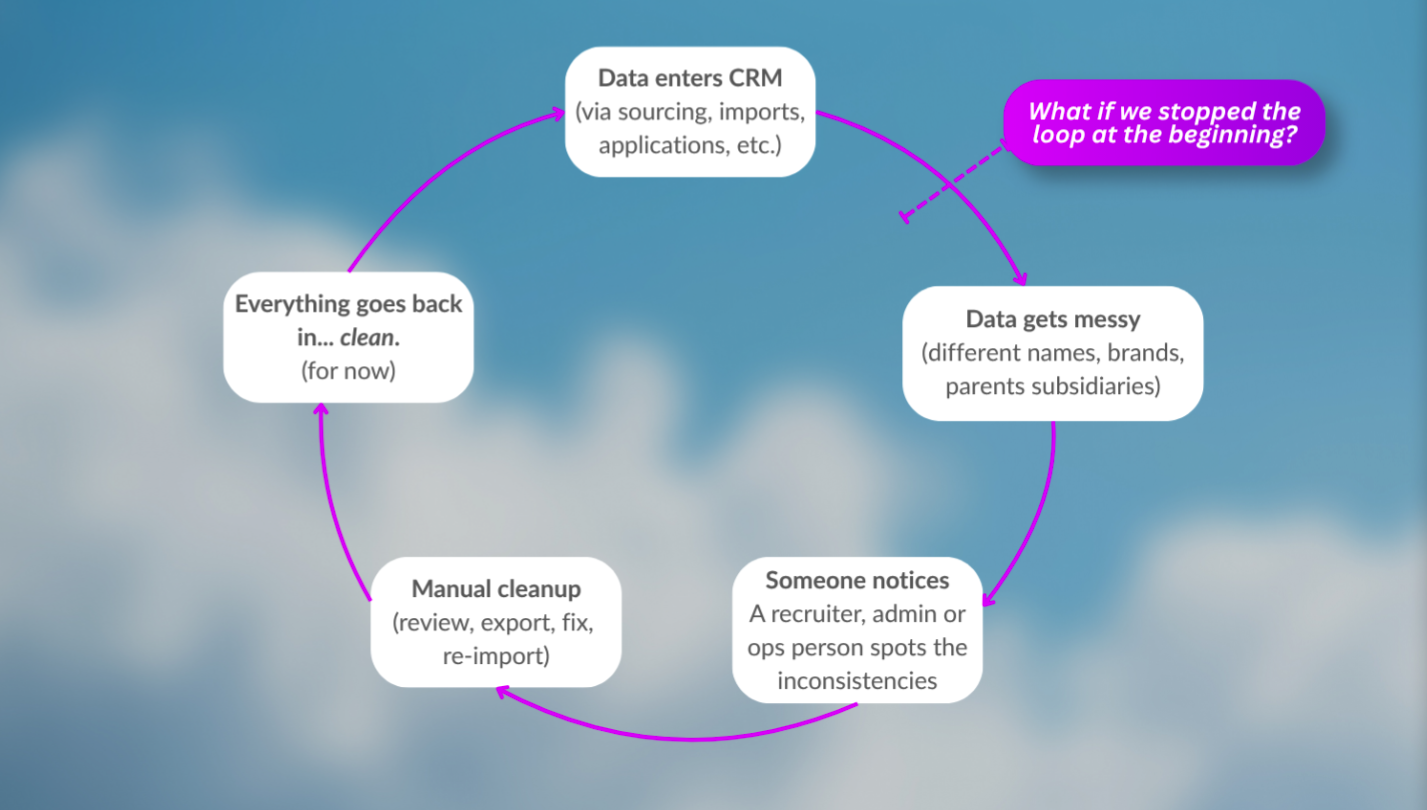
The problems were all in their technology: Data sat stagnant. Systems didn't talk to each other. Nothing learned.
And the hard-won knowledge each recruiter built up stayed locked in their own head, instead of compounding into something the whole firm could draw on.
I didn't think this industry needed one more tool to bolt onto the pile. I thought it deserved something built as one, from first principles. A true system that did the work with you — and got smarter every time you used it.
We chose to build Loxo the hard way
With that in mind, when I started Loxo, I was never setting out to build a better ATS.
From the very beginning, we’ve been crystal clear that we were building an entirely new category — the Talent Intelligence Platform — and we've been working toward the ideal version of it ever since.
In 2013, I brought together the first team, including my co-founder Ilia, alongside designers, engineers, and machine learning researchers.
The brief was simple to say and very hard to do: Reinvent the entire recruiting workflow instead of improving the old one, and put real intelligence at the center of it.
There was an easier path available to us. We could have wrapped someone else's technology, licensed data from outside vendors, and shipped faster. We chose the longer road on purpose, because the only way to build something you could truly rely on — for decades, not just a season — was to build it from the ground up ourselves.
What actually makes Loxo different
There are a lot of good recruiting tools today, and even more popping up every month — and I have genuine respect for the people building them.
I want to be honest with you about what makes Loxo different.
You may have noticed that almost every new tool now calls itself “AI-native.” The reality is that this is no longer a differentiator; it’s table stakes, because every competitive option has a model in their stack.
The question that actually matters is what that intelligence is built on.
Many modern tools rent their intelligence — AKA they wrap a third-party chatbot and license their data from outside vendors.
We spent more than ten years building the layer of intelligence that powers Loxo’s entire platform:
- We built our own talent graph: A dataset of over 800 million people, continuously cleaned, de-duplicated, and enriched by our own systems, so it stays alive instead of going stale in a database.
- We built our own recruiting AI: Proprietary deep-learning models and a knowledge graph now in its seventh generation, not a wrapper on whatever API happens to be popular this year.
- We built it to compound: Your behavior influences the system, so that every search, note, conversation, and hire makes the platform smarter for your firm specifically.
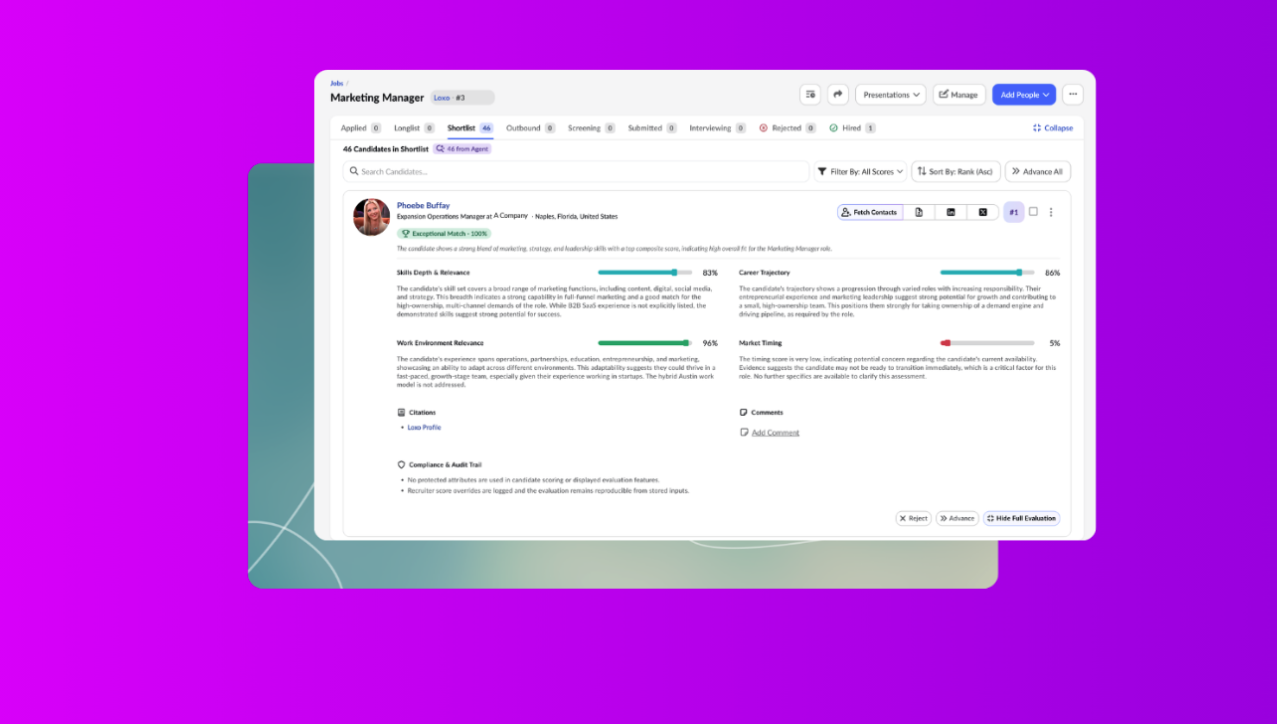
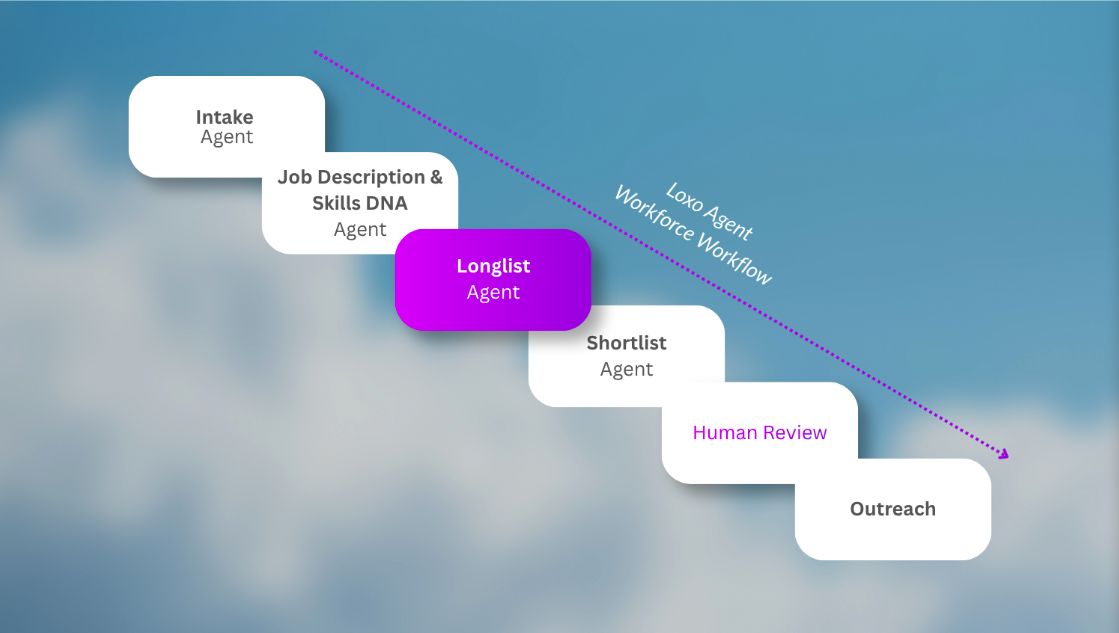
- We built agents to reduce the manual load: The human side of recruitment has always been enhanced by technology, and Loxo’s AI agents take that to the next level, covering memory, data enrichment & cleanup, note-taking, follow-ups, and recommendations — so your people can spend their time where it truly matters.
You can buy a model, but you can't rent a decade of owned data and the intelligence built on top of it.
That's the true Loxo difference, and it's the reason we’ll continue getting better for you long after the noise dies down.
The pursuit of the platonic ideal
I’ve always lived by the belief that how you do anything is how you do everything.
Now, at Loxo, we hire for that belief, and we obsess over it — not to chase perfection for its own sake, but because we genuinely believe you deserve tools that feel effortless.
So we sweat the details most software companies ignore: We care about every pixel. We care about the moment a search returns exactly the right person. We care about you closing your laptop at the end of the day, feeling like your technology was working for you, not against you.
We like to think of it as building toward the platonic ideal of what recruiting software should be. We're not there yet — no one ever fully is — but it's the standard we hold ourselves to, and we get a little closer with every release.
Loxo is built for the long term
I want you to be able to build your business on Loxo with confidence. That means Loxo has to be built to last.
It's the lens we bring to every decision, including how we've grown. We're fortunate to have strong partners and the resources to invest deeply in our data, our AI, and our product for the long haul. After years of being bootstrapped, we recently secured over $115M in growth investment — so we can keep showing up, keep building, and keep earning your trust for years and decades to come.
Thousands of recruiting and executive search firms around the world run their day on Loxo, and we don't take that lightly.
We know that when you choose where to keep your data and run your workflow, you are trusting us with the heart of your business. Our job is to be worthy of that trust every single day, and to still be here — and still be the best — when you need us most.
What this means for you
So here's my promise.
We will keep building the platform you actually need — not necessarily the one that's easiest to market. We'll keep choosing the harder, more durable path: owning our intelligence, sweating the craft, and staying focused enough to put you first.
And we'll keep working, quietly and relentlessly, to help you shape the future.
Thank you for letting us build it with you. We're just getting started.
Matt Chambers Founder & CEO, Loxo