


Here’s a hard truth: the modern inbox is a battlefield where emails go to die.
Most cold emails fail for a few simple reasons: they are generic, predictable, and easy to ignore.
Your prospects and candidates aren’t reading your messages. They’re scanning them, quickly deciding whether it’s worth even a few more seconds of attention. The average human attention span is estimated at just 9 seconds. In reality, for cold outreach, it’s even shorter.
If your message doesn’t feel relevant immediately, it gets skipped.
That means:
- Your subject line has to earn the open
- Your first line has to earn the read
- And your message has to earn the reply
All within seconds.
But here’s the challenge (you’re probably already thinking this)...
Most recruiters were never formally trained on copywriting best practices. Things like:
- How to structure a message
- How to create relevance
- How to guide attention
…So they default to what they’ve seen before.
And that’s exactly why most outreach looks the same.
This guide changes that, by giving you:
- Proven copywriting frameworks
- Real outreach examples
- Personalization strategies that actually work
- Benchmarks and testing methods
- Advanced techniques most recruiters overlook
Throughout this guide, keep in mind: the goal isn’t to simply “sound better; it’s to increase responses and have better conversations.
The recruiter’s copywriting mandate
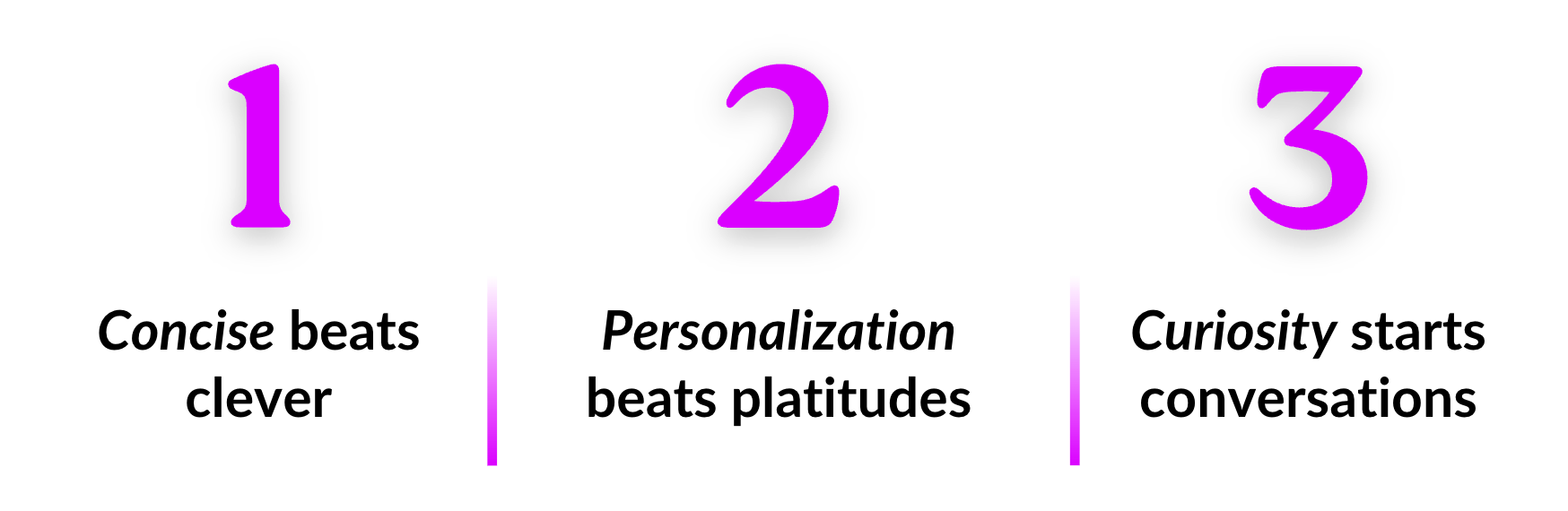
If you can repeat these statements to yourself over and over again—a mantra, in three parts—your copywriting will instantly become better than that of 80% of recruiters today.
Say it with me:
Concise beats clever.
Personalization beats platitudes.
Curiosity starts conversations.
These statements go beyond a mantra, though—they’re a filter you can pass every single message you write through.
Concise beats clever
Are you asking for too much?
Sometimes the best email is the one that takes the least time to read. The ultra-short framework (under 4 lines) works perfectly for busy prospects. It removes confusion and fluff to get straight to the point. Shorter emails reduce friction, respect time, and force clarity.
One of the biggest mistakes recruiters make is over-explaining.
Long emails don’t fail because people can’t read them. They fail because people won’t. Cognitive load matters. The more effort it takes to process your message, the less likely someone is to engage.
Specificity beats cleverness, every time
A lot of recruiters try to be memorable by being clever. But cleverness without clarity creates confusion—and confusion kills response rates.
Specificity does three things immediately:
- It signals this isn’t a mass message
- It builds credibility
- It helps the reader quickly decide if it’s relevant
This aligns with what’s known in behavioral science as processing fluency—the easier something is to understand, the more trustworthy and appealing it feels.
We’ll get more into personalization and relevance later, so keep all of this in mind! For now, consider these examples:
WEAK
“Exciting opportunity at a fast-growing company”
STRONG
“You’d be the first hire focused on building outbound from scratch across North America”
One is just noise, whereas the other creates a strong mental picture.
Practical filter:
If your sentence could apply to hundreds of roles, it won’t stand out in one inbox.
Write for skimming, not reading
Most outreach is written like it will be read line by line. But the reality is, this is an email, not the next great American novel. If you’re able to get people to open your emails, the reality is that most of them will scan or skim them, not dig deep on a line-level.
Eye-tracking studies consistently show that people scan emails in an F-pattern:
- First line
- Left edge
- Quick jumps
Which means:
- Dense paragraphs get skipped
- Buried value gets missed
- Long intros lose attention
To adapt to this, your writing should:
- Use short, digestible lines
- Front-load the most important information
- Remove anything that slows comprehension
Ask yourself: "Could someone open this email and understand what it’s getting at in 5 seconds?"
If not, simplify.
One strong idea per message
Clarity isn’t just about length—it’s also about focus. When you try to communicate multiple ideas at once, none of them land clearly.
This is a common failure pattern we see in recruitment emails. By trying to say too much, you end up not saying anything at all—or your reader has tuned out before you ever get the chance to really make your case.
Recruiters are used to wearing more than one hat, and they often write their outreach to do so, too:
- Explaining the company
- Describing the role
- Listing benefits
- Adding culture points
…All in one message.
The result? Cognitive overload.
Strong outreach has one job: to give the reader a clear reason to respond. A message that covers too many bases has too many loose ends that the reader may feel like they have to pursue. Instead of painting a landscape, try to hook them on a detail, and then see where the conversation goes from there. Think Picasso, not Dali.
Personalization beats platitudes
There was a time when adding a first name to a subject line increased open rates. That time is over. Call it Marky Mark, because relevance is the new kid on the block.
Today’s inbox is saturated with “personalized” messages that aren’t actually personal, which means the bar has moved.
Personalization is no longer about identity. It’s about relevance.
What is relevance though, and how is it different from personalization?
Relevance answers one question instantly: “Why is this message for me?”
If that answer isn’t obvious, the message gets ignored.
True personalization these days looks a lot more like actually understanding something about your audience/recipient than it does simply knowing their name and email address.
Strong personalization shows that you understand what the recipient has done, what that means, and what comes next. This knowledge creates immediate trust.
What relevance actually looks like
Relevance is built by connecting dots the reader already recognizes:
- Their work
- Their context
- Their likely priorities
This is where most outreach fails—because it references the past without connecting it to the future.
Why relevance works
Relevant messages reduce decision effort. Instead of asking the reader to figure out whether this email is worth their time, you answer it for them.
That’s why relevance consistently drives:
- Higher open rates
- Higher reply rates
- Higher quality conversations
Examples of relevance in action:
WEAK
“Hi [First Name], let’s connect!”
→ No signal, no context, no reason to care
STRONG
“How [Company] is scaling [specific function] right now…”
→ Tied to something real and current
WEAK
“I saw you work at [Company] and wanted to reach out…”
→ Observation without meaning
STRONG
“I saw your team is expanding into [market]—how are you thinking about scaling hiring in that region?”
→ Observation + implication + relevance
Timing > wording (the hidden variable)
It may seem like, throughout this guide, we’re obsessing over wording—but the caveat here is that timing often has a bigger impact than any other variable. It’s also one of the strongest levers you can use when crafting relevant, personalized messages to both candidates and prospective clients.
A perfectly written message sent at the wrong time will underperform a decent message sent at the right time.
Why? Because relevance is temporal.
Which is just a fancy way of saying…people are more responsive when they’re:
- Approaching a transition
- Experiencing change
- Evaluating what’s next
This is why tracking signals matters. Signals like:
- Tenure (1.5–4 years is often a transition window)
- Promotions (lower responsiveness immediately after)
- Funding events
- Hiring spikes
- Layoffs (especially at adjacent companies)
Because great outreach isn’t just well-written; it’s well-timed.
What the data says on relevance and personalization
Across outbound research (sales + recruiting overlap heavily):
- Personalized messaging tied to specific work or behavior can increase reply rates by 2–3x
- Messages that include contextual relevance outperform generic personalization by 30–50%+
- Token personalization (names, companies only) has negligible impact
The takeaway: Personalization only works when it changes the meaning of the message—not just the appearance.
A practical personalization system for recruiters
Use this mental model:
- Signal → what did they do?
- Interpretation → what does that mean?
- Connection → why this role?
Remember: Relevance goes beyond the "tricks" of personalized fields and speaks directly to what’s important to the recipient right now. It’s about anticipating their needs or concerns and offering a solution, making your outreach far more likely to resonate.
Curiosity starts conversations

Curiosity is not a gimmick. It’s a psychological trigger.
George Loewenstein’s Information Gap Theory explains that when people notice a gap between what they know and what they want to know, they feel a natural urge to close that gap.
Good outreach leverages this by:
- Giving partial information
- Highlighting something relevant
- Inviting a question
Instead of pushing information, it pulls engagement.
The goal? Spark a simple question in the reader’s mind. Open with something that feels relevant but incomplete. Invite them to THINK rather than simply pushing an agenda.
Try for pattern interruption (without being gimmicky)
Most recruiter outreach follows the same pattern:
“Hi [Name], I came across your profile…”
The brain recognizes this instantly—and tunes it out. It’s one of a dozen-plus emails like it that the recipient will see this week.
Pattern interruption works because it breaks that expectation. Your brain recognizes this as novel, and wants to lean in closer.
But there’s a fine line to walk here.
Too safe → ignored
Too clever → distrusted
The goal is not to be shocking per se, but rather to be unexpected-but-relevant.
One of our CSMs at Loxo loves to use dad jokes in subject lines to break up the noise and pique interest. They’re playful and fun, but she always finds a way to tie them back to the message she’s sending.
Instead of thinking of this challenge as a tightrope walk, think of it as a fun puzzle to solve. You want to find ways to connect that feel human and relevant.
The “so what?” test
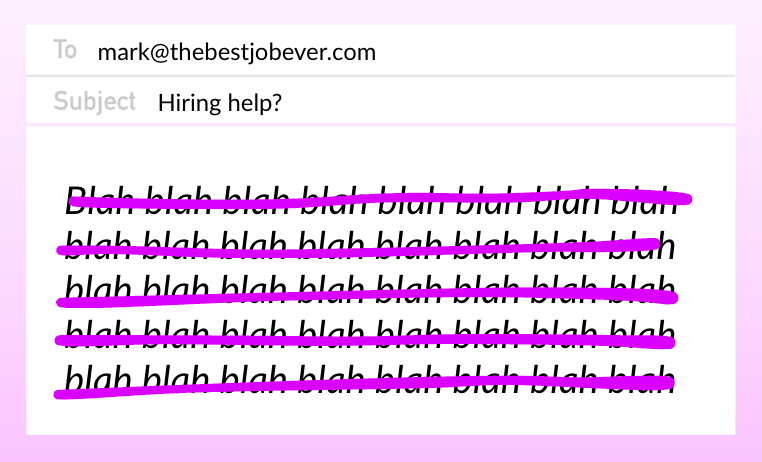
The “so what?” test is your ultimate copy filter and new best friend—a best friend who is an expert in tough love.
The gist is this: if you can’t justify a sentence, it’s dead weight. Delete it.
Most outreach fails because it includes information that doesn’t matter to the reader. The “So What?” test forces you to remove it.
Every sentence should justify its existence.
Ask:
- Why does this matter to them?
- Does this move them closer to responding?
- Is this creating value—or just filling space?
If you can’t answer clearly, cut it.
Here are some examples of the “so what?” test in action:
WEAK
“You’ll manage a team of 5 recruiters”
STRONGER
“You’ll manage a team of 5 recruiters and define how hiring scales as the company doubles headcount”
→ Same fact, but now it answers: why does this matter to me?
Make it about “you,” not “I”
When it comes to passing the “so what?” test, this is one of the biggest copywriting unlocks. We mentioned at the very beginning of this guide that attention is limited and inboxes are cluttered.
It would make sense, given those facts, that people would process information through a self-interest filter: “Why should I, specifically, care?”
Your message competes with:
- Other emails
- Internal priorities
- Ongoing work
So the recipient is sifting through all of that, skimming and scanning, asking: “Is this relevant to me right now?”
Language that centers the reader—keeping the focus on them, not you—answers that faster. It’s a shift from simply explaining the role to positioning the outcome, and painting a picture that puts the reader front and center.
Most outreach sounds like:
- “I’m working with a client…”
- “We’re hiring for…”
- “I wanted to reach out…”
This is sender-focused copy.
High-performing recruiter outreach is reader-focused:
- About their goals
- Their pain
- Their trajectory
Quick rewrite formula
If you do this one thing, you’ll already be improving your outreach by leaps and bounds.
Take any sentence and flip:
- “I / we” → “You”
- “The role is…” → “You’ll be…”
- “We need…” → “You’ll get to…”
Here are some examples of this flip in action:
WEAK (recruiter-centric)
“I’m working with a fast-growing company looking for a Senior Engineer.”
STRONG (candidate-centric)
“You’d be stepping into a role where you own the architecture decisions for a system that’s about to 10x.”
WEAK (recruiter-centric)
“We’re excited about this opportunity.”
STRONG (candidate-centric)
“This role gives you direct ownership over [something relevant/specific to them].”
WEAK (recruiter-centric)
“I thought you’d be a great fit.”
STRONG (candidate-centric)
“Your experience with [specific thing] lines up closely with what this team needs next.”
Remove “defensive writing”
Many job descriptions and outreach include language designed to filter candidates — but in early outreach, this creates friction. And rather than filtering out candidates who aren’t a good fit (which, if you’re targeting appropriately, shouldn’t be an issue anyway), you may end up alienating those who are.
Some examples of defensive language that may be showing up in your outreach:
- “must be able to…”
- “required to…”
- “ideal candidate will…”
These phrases are common (and overused)—but beyond that, they create distance and separation that doesn’t invite this specific recipient into a conversation. Instead, they feel cold and sterile, while also making the candidate on the receiving end feel like there are more reasons they won’t be a fit than that they will.
At their core, these phrases signal evaluation, not invitation or opportunity.
Some simple swaps that make your messaging less defensive and more inclusive:
- “You’ll be working on…”
- “This role is a great fit if you’ve…”
- “Your experience in X will really serve you with Y…”
Ultimately, these messages have the same (or similar) meaning, but much better tone.
Include social proof—but make it specific
Humans look for signals of safety and success—but generic claims don’t provide that. We’ve all seen enough false evidence to default to skepticism without specificity.
Specific, tangible proof does a lot to make your case—and can speak louder than any message you string together.
Why? For a lot of reasons, but partially because of social validation bias: people trust what others have already validated.
So how do you do social proof the right way? Let’s look at a few examples:
WEAK
“Great culture and growth opportunities”
STRONGER
“3 people on this team have been promoted in the last 12 months”
“We’ve placed 4 people here in the last year—2 have already moved into leadership roles”
Now, what would take this to the next level?
Quotes or other forms of documented success (!!!)
Have a case study with quotes from a happy client who you helped secure their latest VP who’s killing it in their role? Or what about a candidate who is a year into their role and couldn’t be happier? Amazing.
Specific proof builds trust fast—and that’s exactly what you should be aiming for in both your candidate and client outreach.
Three copywriting frameworks for recruiters
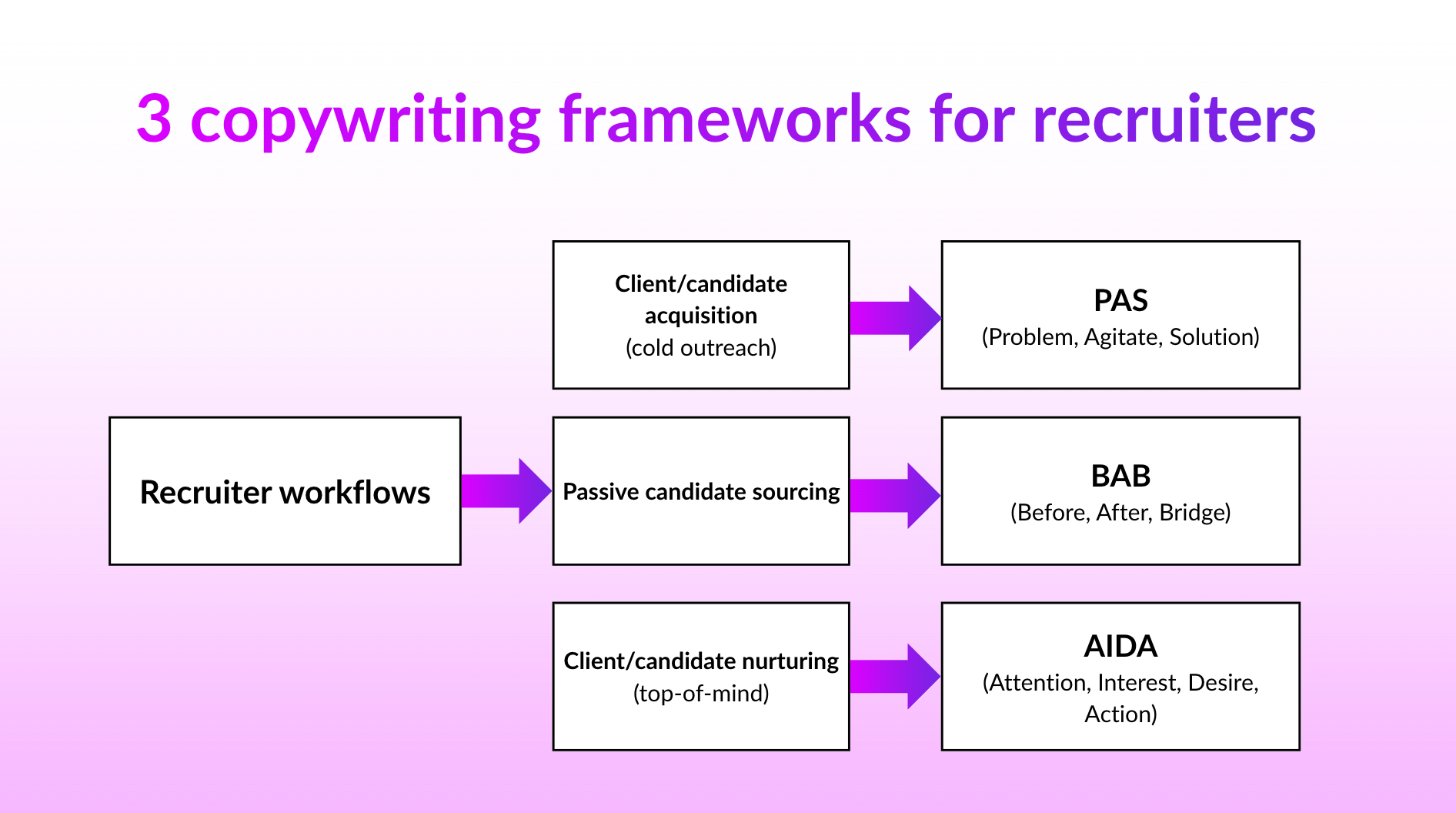
Frameworks reduce decision fatigue—and make the process of writing outreach messages feel a bit less daunting. Instead of starting from zero, you’re strategically populating a proven template.
These frameworks act like blueprints for outreach messages—designed to improve performance, consistency, and confidence.
Better yet: each of the three frameworks we’ll get into here are rooted in copywriting best practices.
Curious for more on this subject? Check out our webinar on copywriting frameworks.
Framework 1: PAS
Pain → Agitate → Solution
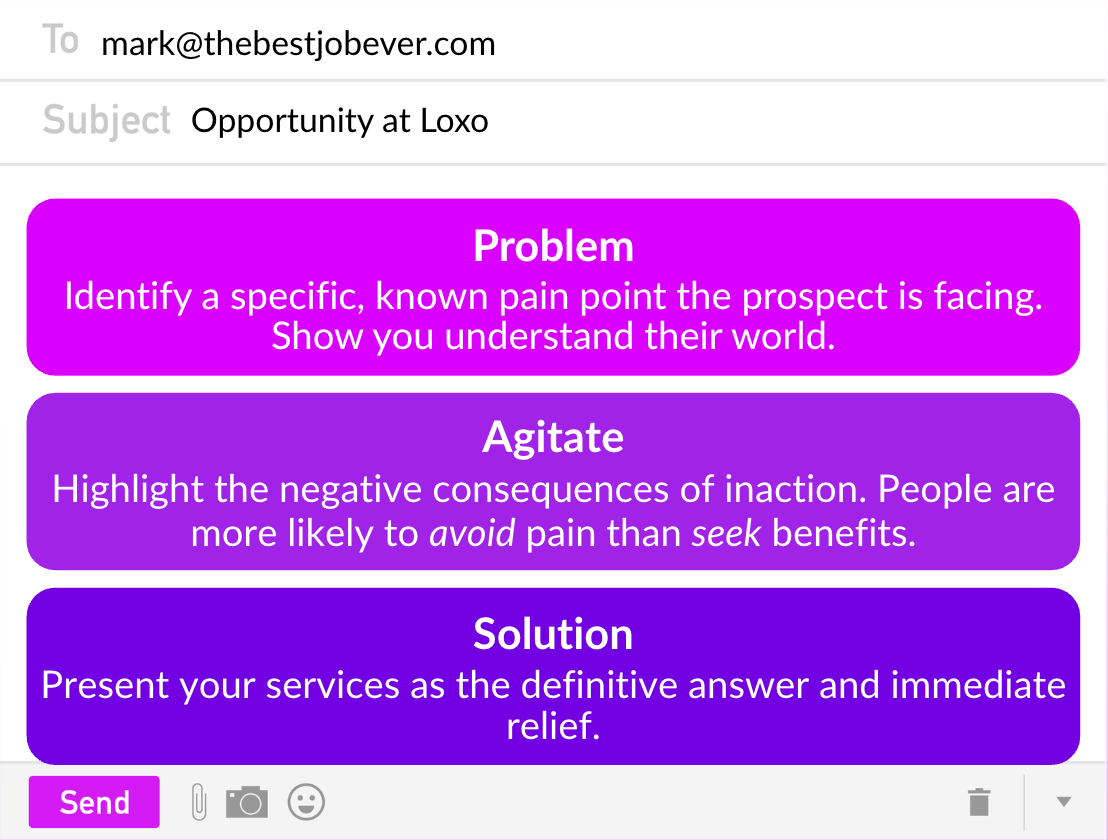
Structure:
- Identify a problem
- Show why it matters
- Suggest a solution
Best for: Roles tied to fixing real pain (inefficiency, burnout, bad tooling)
Example:
Subject: Still dealing with [pain]?
Hi [First Name],
A lot of [role] professionals I talk to are still dealing with [specific pain—e.g., fragmented data, manual sourcing, reactive hiring].
It usually means:
- Wasted time on [task]
- Limited visibility into [insight]
- And slower impact than they’re capable of
We’re working with a team that’s solving this by [clear solution], and they’re bringing in someone to own it end-to-end.
Would it be crazy to explore?
—[Your Name]
Framework 2: AIDA
Attention → Interest → Desire → Action

Structure:
- Capture their attention
- Provide interesting context
- Showcase opportunity or value
- Invite them to continue the conversation
Best for: Structured, persuasive outreach where you need to guide attention
Example:
Subject: Scaling [specific function] at [Company]
Hi [First Name],
Saw your work on [specific project / initiative]—especially how you approached [detail].
We’re working with [Company], who’s tackling a very similar challenge: [specific problem].
What’s interesting is they’re doing it with [unique angle: new data model, AI layer, global scale, etc.], and the person in this role will directly shape how that evolves.
Open to a 10-minute intro to see if it aligns with what you want next?
—[Your Name]
Framework 3: BAB
Before → After → Bridge
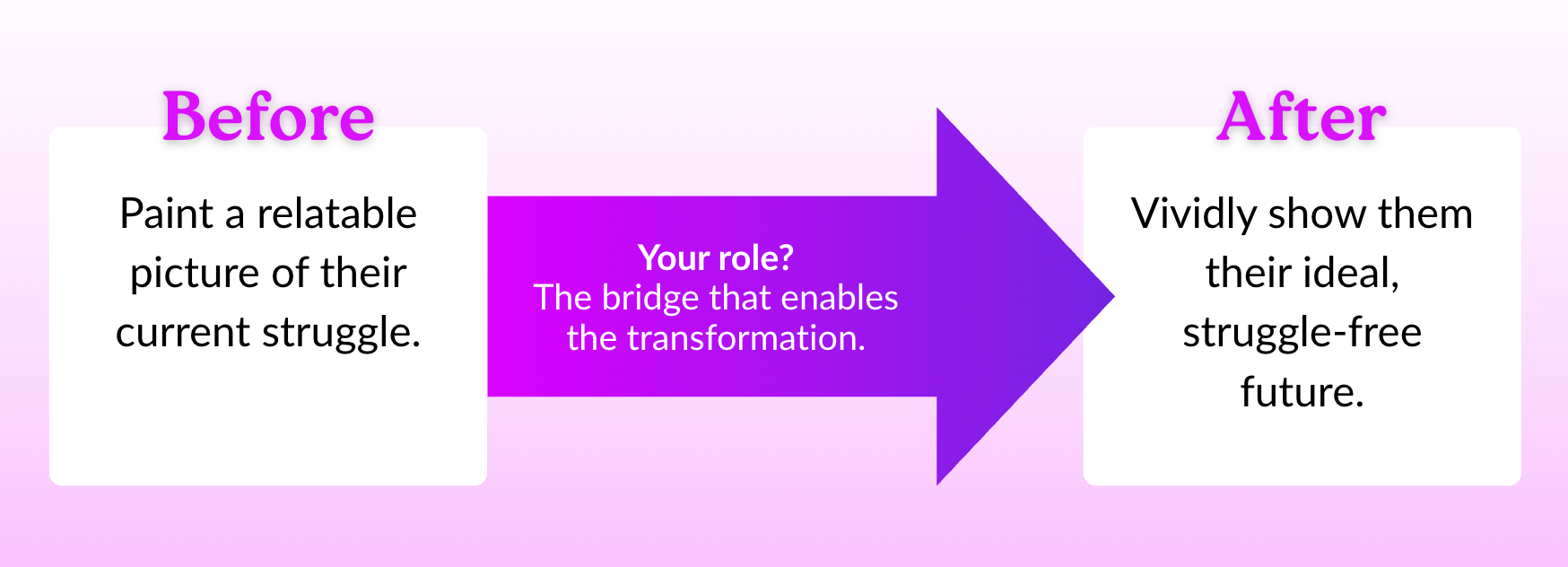
Structure:
- Before: Current situation/friction
- After: Better future
- Bridge to the opportunity/how this role gets them there
Best for: Transformational roles, career growth, moving someone out of frustration
Example:
Subject: Your next step beyond [current limitation]
Hi [First Name],
Most [role] leaders I speak with are stuck managing [manual process / outdated stack / limited scope]—great work, but not exactly career-defining.
What if you were leading [new initiative, modern stack, bigger scope] with real ownership over [impact area]?
We’re helping a team at [Company] build exactly that. They’re investing in [specific change], and they need someone who’s already proven they can [relevant achievement].
Worth a quick conversation to explore?
—[Your Name]
Candidate vs client copy is a different game
This may go without saying, but the way recruiters talk to candidates compared to how they talk to clients may be vastly different—not even so much in tone, but in content. The motivations and interests of these parties are distinct, and you need to tailor your outreach accordingly.
→ Candidates are evaluating: “Is this a better future?”
→ Clients are evaluating: “Is this a better outcome?”
Different motivations require different messaging.
If you use the same copy for both, you dilute effectiveness.
These are suggestions, not hard-and-fast rules, but some of the tips below may help you start to calibrate your outreach appropriately, depending on the recipient.
Candidate outreach
In general, candidate outreach can skew a bit more casual than client outreach—but not so much that you’re sacrificing trust.
The real difference is that you may be bringing emotional or aspirational language into the mix. You’re adopting a future-focused mindset, inviting the candidate to wonder about how this role may fit into their plans, goals, and dreams.
You’re asking the candidate “What’s next for you?” all while providing a potential answer to that very question.
Client / business development outreach
Client outreach, by its very nature, can tend to be a bit more buttoned-up—but you don’t want to forget that the person on the receiving end is a human. They may be more inclined to care about business impact and ROI than a candidate, but that doesn’t mean emotional or aspirational language doesn’t have its place.
You want to think about client outreach as a way to build both rapport and trust.
You’re asking the prospect “What problem can I solve for you?” and demonstrating that you have the expertise to solve it right from the jump.
Want more information on effective Account Based Prospecting for Recruiters? We’ve got a resource that goes deep on this subject.
Tone matching
You may be picking up on a theme here…and that theme is that tone matters.
Tone signals understanding. If your tone doesn’t match the audience, it creates subtle—but impactful!—friction. Tone isn’t just style; it’s positioning in action.
Your tone should match:
- The recipient
- The role
- The seniority
- The industry
Testing what works for YOU
Most recruiters rely on intuition. But intuition doesn’t scale. Testing creates feedback loops that help you determine what resonates, what doesn’t, and how to improve over time.
Without testing, improvement is random.
With that in mind, experimenting to find the frameworks that work best for you, your business, and your recipients is key.
Your company, your clients, and your candidates are unique. It’s important to test over time to make sure you’re getting the best response rates possible. There is no universal “perfect message.”
What works depends on a whole host of factors, including:
- Role type
- Seniority
- Industry
- Market conditions
- …and so much more
But any experiment needs a good hypothesis—and a good understanding of what “good” is.
Baseline benchmarks (cold outreach)
When conducting outreach experiments, understanding your baseline is critical, so you can measure the success of each of your sends against.
These ranges are directional—not absolute. High performers often exceed them not because of better copy alone—but because of tighter targeting, stronger relevance, or better timing.
These vary, but generally…
Open rates
- 40–60% = solid
- 60–75% = strong
- 75%+ = excellent (usually great targeting + subject lines)
If you’re below these, it’s usually due to:
- Weak targeting
- Generic messaging
- Poor subject lines
Reply rates
- 5–10% = average
- 10–20% = strong
- 20%+ = top-tier (rare, usually highly targeted roles)
If your open rates are strong but your reply rates are below average, you may want to consider experimenting with a different framework or improving your messaging using some of the tactics listed in this guide. Maybe you’re not giving enough detail—or maybe you’re giving too much.
What to A/B test (in order of impact)
You may be wondering, “Okay, all of that sounds great…but where do I start? What do I test?”
There are several variables you can bring into the mix for the early stages of experimentation.
But keep in mind: testing isn’t about finding a “winner.” It’s about understanding patterns and making subtle improvements over time.
Variables to experiment with:
- Targeting
- Job titles
- Company types
- Seniority
- Subject lines
- Curiosity vs direct
- Personalized vs generic
- Short vs slightly longer
- Emojis vs no emojis
- Silly vs serious
- Opening line of the email itself
- Personalized vs not
- Question vs statement
- Value proposition
- Growth vs compensation vs impact
- Problem-focused vs opportunity-focused
- Call to action
- “Open to chatting?”
- “Worth a quick convo?”
- “Should I send more info?”
What to track:
- Open rate (subject line and targeting effectiveness)
- Reply rate (messaging effectiveness)
- Positive replies (true success!)
How to run clean tests
The first rule of any experiment? Only change one variable at a time. Otherwise, you’re ruining the integrity of the results—you won’t know which specific variable is responsible for the changes you're seeing.
If you want confidence in your data, it’s recommended that you track a minimum of 50–100 sends per variant before making any major determinations. The larger the sample size, the more confident you can be that there aren’t any flukes skewing your dataset.
One more note:
When experimenting, it’s best to keep email deliverability best practices in mind. We’ve got a helpful resource on email deliverability here.
Friction kills replies
Every additional decision you ask the reader to make reduces response likelihood. This is known as choice overload.
Recruiters often add unnecessary friction without even realizing it. That unnecessary friction can look like:
- Long emails
- Multiple links (they don’t know what action to take, so they take none instead)
- Asking for resumes immediately
- Overly formal, forced, or pushy scheduling
A simple CTA works because:
- It’s easy to process
- It requires minimal commitment
- It lowers perceived risk
You’re not asking for a meeting yet—you’re asking for a conversation.
Here are some better CTA examples you could try using:
- “Worth a quick chat?”
- “Open to exploring?”
- “Should I send more context?”
The biggest goal? Make the first yes easy.
Follow-ups are where most wins happen
There’s a known effect in outreach: response probability increases with thoughtful follow-ups. Long story short? Most replies don’t come from the first email; they come from follow-ups.
But only when each message adds value and feels intentional.
But many recruiters send the same message again or just say “bumping this.” Adding new context is what signals effort and expertise.
Your rule? Each follow-up should add new value:
- New insight about the role
- New angle (team, impact, growth)
- Social proof (“just placed someone from X into this team”)
Remember: consistency compounds
This is what separates good recruitment outreach from great, repeatable success.
Great copy helps. But consistency is what actually drives results. It’s also where most recruiting teams fall short. They test once, change direction, and then stop there, never building a true system.
Repeatable, scalable, predictable results come from:
- Consistent testing
- Consistent iteration
- Consistent follow-ups
Small improvements → repeated over time → compound into significant gains.
In conclusion

Effective recruiters don’t rewrite outreach messages every day—they build systems.
Those systems include:
- Candidate outreach templates
- Client outreach templates
- Follow-up messages
- Outreach sequences
- Feedback loops & experiments
Your takeaways
The best recruiter outreach sits at the intersection of:
- Repeatable structure (frameworks like AIDA, PAS, etc.)
- True personalization (relevance, not fluff)
- Constant testing (no assumptions)
- Candidate-first framing (“you,” not “I”)
This is where AI-native platforms like Loxo’s Talent Intelligence Platform make a big difference. True talent intelligence sits at the intersection of a smart platform and a repeatable workflow—and great outreach in modern times depends on those factors, too.
We’ll leave you with this:
Relevance beats volume. Specificity beats creativity. Iteration beats instinct.


