Why your job description is failing your search (and how Skills DNA fixes it)
Most recruiting software on the market today is racing to make writing job descriptions faster, selling AI as an automated pen that turns bullet points into paragraphs in the blink of an eye. But while that sounds helpful, it misses the point and ignores the root problem: The disconnect between what a hiring manage r actually needs and what the job description says. (University of Washington).
You know how it goes: skills drift over time, requirements get copied from a requisition filled years ago, or the resulting text is vague enough to describe three completely different candidates. As one in-house TA team put it, "there can be a little bit of a difference” between “what the hiring manager says and what the JD says."
And when the job description is closer to a wish list than a precise specification of what the team really needs, it becomes a shaky foundation for the systems you build on top of them. Right now, the hiring industry is using the job description as the source of truth for search engines, candidate matching algorithms, scorecards, and submittals (UC Berkeley). All that from a document designed to be an easy overview of the role for human eyes only.
Treating a static document as your primary data structure means every downstream step inherits its flaws. And those expensive autopens that other recruiting platforms are racing to develop won’t resolve the fundamental truth:
→ A job description is a document.
→ Your hiring workflow is a system.
= Confusing the two creates an architecture problem.
What is the cost of building on a shaky foundation?
When you start with inaccurate or unclear information, those problems carry through every step that follows. Search engines have to work out what the hiring team actually means based solely on keywords. Matching systems have to guess at context. Scorecards have to interpret information buried in paragraphs. And recruiters have to explain why a candidate is a great fit based on incomplete or blurry requirements.
Recruiters feel the impact of this every day:
- Candidates look right on paper but fail the intake interview.
- Sourcing filters generate lots of applicants but struggle to find the right ones.
- Recruiters spend hours going back and forth with hiring managers to clarify requirements that should have been clear from the start!
The time and cost add up quickly. Industry data shows that recruiters spend more than 17 hours per vacancy on administrative tasks (SIA). And when requirements change mid-process, the work often has to start again — extending an already lengthy time-to-fill.
In the long run, the impact isn't just operational. When a shortlist is still missing the mark three weeks into a mandate, it damages trust between recruiters, hiring managers, and clients.
How does this gap impact different recruiting workflows?
Every recruiting segment faces this same problem, but it shows up differently depending on the business model:
- Executive Search: Consultants work directly with clients to define the role. Speed is less important than depth and accuracy, so the mandate needs to be detailed enough to hold up to senior-level scrutiny.
- Direct Hire Agencies: Recruiters often receive job descriptions they didn't write and can't fully rely on. The requirements may already have been filtered through salesperson notes, leaving recruiters to search based on incomplete or inaccurate information.
- In-House TA: Teams can be managing up to 40 open requisitions across 40 different hiring managers. Recruiters often don't have the leverage to ask for a complete rewrite, so they have to work with whatever job description they're given.
- Temp & Contract: Recruiters often have even less information to work with. A basic VMS job order may only include a pay rate and location, which isn't enough to support accurate automated matching.
- RPO: Teams often build specifications across multiple systems and spend significant time waiting for a usable job description before sourcing can begin.
The workflow changes from one recruiting model to another, but the underlying gap remains the same: the information needed to make good hiring decisions isn't captured in a structure built to support the work. Same sized gap, just different shapes.
→ Read some of Loxo’s Customer Stories HERE.
What does the Job Description & Skills DNA Agent actually do?
The Job Description & Skills DNA Agent completely reverses the traditional approach. Instead of starting by writing a job description, it builds the underlying role intelligence first. The job description is then generated from that information, rather than being treated as the source of truth.
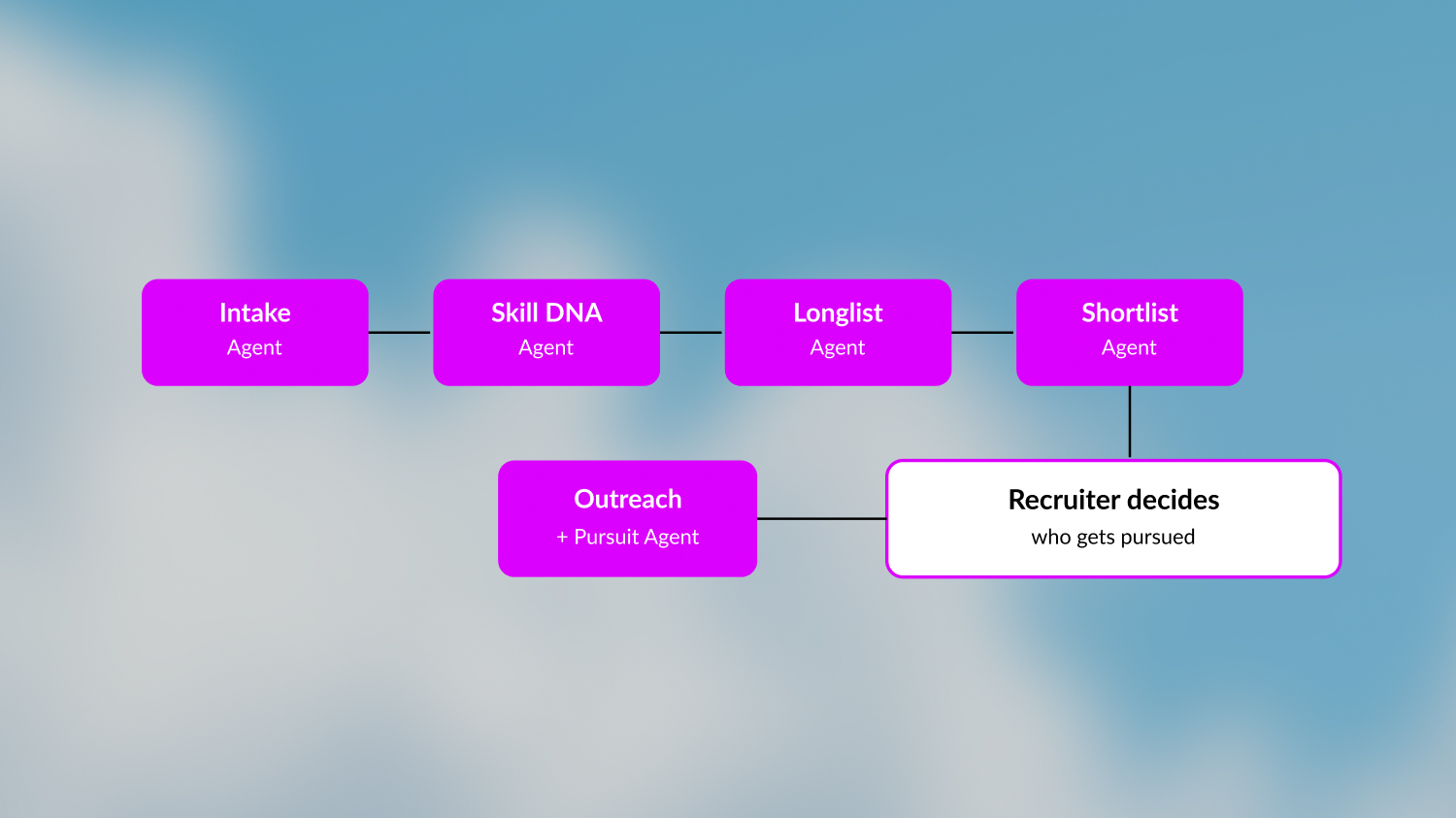
Working alongside the Intake Agent, which captures and structures the conversation from the intake call, the system combines market data, organizational context, and skills data to build Skills DNA. It identifies the core competencies, separates must-haves from nice-to-haves, defines the right level of seniority, and grounds the role in current market conditions.
Because Loxo's native tools all work from the same Skills DNA, the hiring requirements stay consistent across search, matching, scorecards, and submittals.
This isn't another AI copywriting tool, and it doesn't replace the recruiter. The recruiter's expertise still drives the intake call and the decisions that follow. The agent simply turns that human input into structured data, reducing the risk of requirements being lost or changed as they move through the hiring process.
Why does structured role intelligence matter for the Agent Workforce?
When intake captures an unstructured conversation, Skills DNA turns that information into a structured, persistent foundation. It becomes the first piece of structured role data that the rest of the platform can use and build on.
Without structured data, hiring workflows have to rely on text that software can't properly evaluate, compare, or improve. With Skills DNA, every search starts from the same clear, trackable definition of the role.
As the first structural link in the Loxo Agent Workforce, Skills DNA feeds everything that comes next:
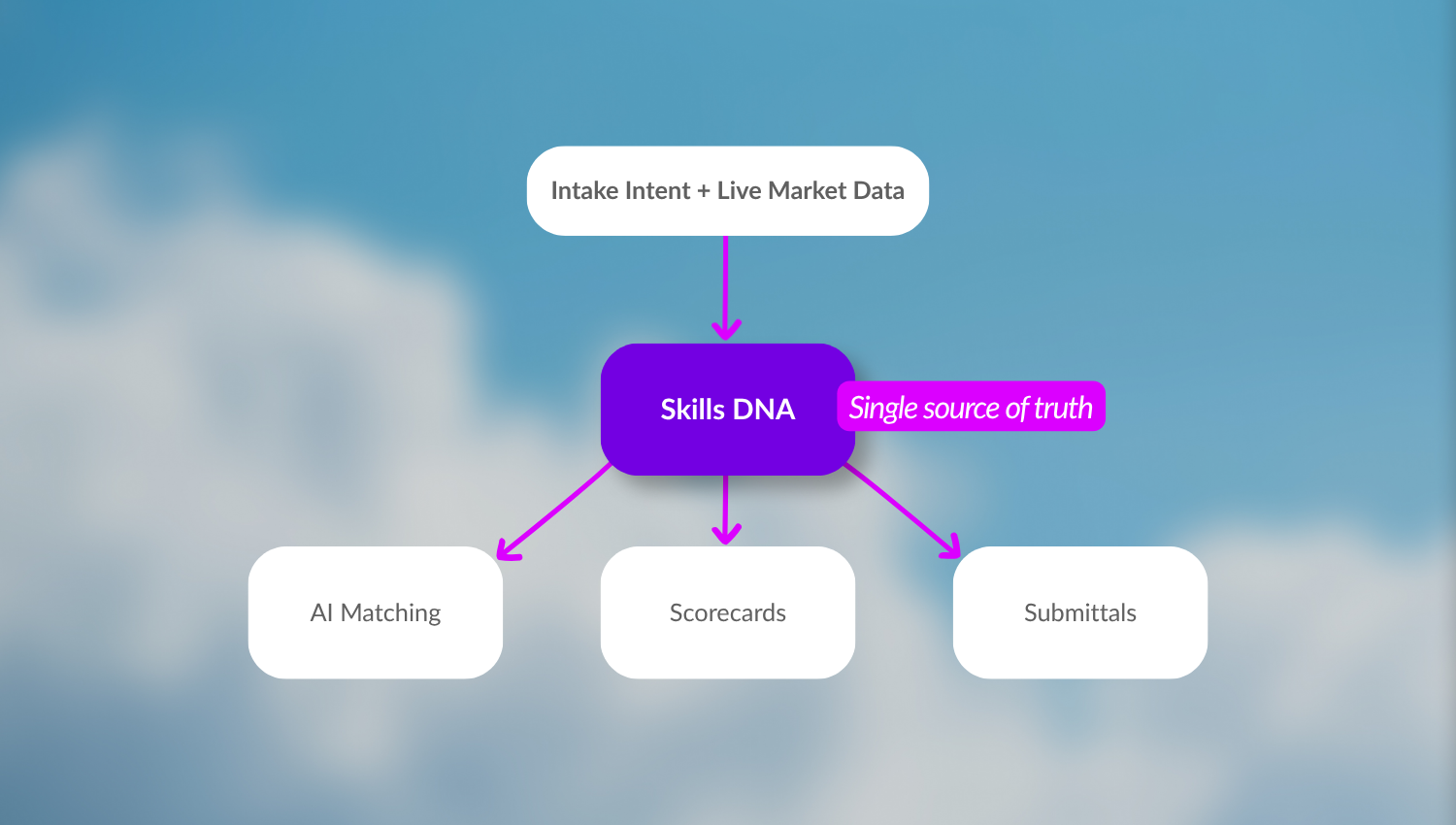
Search engines, matching algorithms, evaluation scorecards, and client submittals all reference the exact same definition of the role. Instead of each step reinterpreting a static job description, the system carries the original requirements through the entire workflow.
Starting with a clear, structured foundation leads to better outcomes: more accurate candidate matches, fewer abandoned searches, better alignment with hiring managers, and stronger submittals.
The result is more than a better way to create a job description. It gives every part of the hiring workflow the same source of truth — so the right information stays intact from the first conversation to the final candidate.
→ Read more about how Loxo’s JD & Skills DNA Agent builds the structured role intelligence behind the job description first.
<script>
{
"@context": "https://schema.org",
"@graph": [
{
"@type": "BlogPosting",
"@id": "https://www.loxo.co/blog/why-job-descriptions-fail-skills-dna#article",
"headline": "Why Your Job Description Is Failing Your Search (and How Skills DNA Fixes It)",
"description": "A job description is a document; your hiring workflow is a system. See why that gap breaks search and matching — and what Skills DNA replaces it with.",
"url": "https://www.loxo.co/blog/why-job-descriptions-fail-skills-dna",
"mainEntityOfPage": { "@type": "WebPage", "@id": "https://www.loxo.co/blog/why-job-descriptions-fail-skills-dna" },
"datePublished": "2026-09-03",
"dateModified": "2026-09-03",
"inLanguage": "en-US",
"author": { "@type": "Organization", "name": "Loxo", "url": "https://www.loxo.co" },
"publisher": {
"@type": "Organization",
"name": "Loxo",
"url": "https://www.loxo.co",
"logo": { "@type": "ImageObject", "url": "https://www.loxo.co/[LOGO-PATH].png" }
},
"image": { "@type": "ImageObject", "url": "https://www.loxo.co/[HERO-IMAGE].jpg", "width": 1200, "height": 630 },
"articleSection": "Recruiting Operations",
"keywords": "skills-based hiring, job description, skills DNA, recruiting intake meeting, job requisition, skills taxonomy, AI agents for recruiting",
"about": [
{ "@type": "Thing", "name": "Job description" },
{ "@type": "Thing", "name": "Skills-based hiring" },
{ "@type": "Thing", "name": "Recruitment" }
],
"mentions": [
{
"@type": "SoftwareApplication",
"name": "Loxo Job Description & Skills DNA Agent",
"applicationCategory": "BusinessApplication",
"url": "https://www.loxo.co/ai-agents/job-description-skills-dna-agent"
},
{
"@type": "SoftwareApplication",
"name": "Loxo Intake Agent",
"applicationCategory": "BusinessApplication",
"url": "https://www.loxo.co/ai-agents/intake-agent"
}
],
"citation": [
{ "@type": "CreativeWork", "name": "Job Posting Components", "url": "https://hr.uw.edu/talent/hiring-process/preparing-for-and-conducting-the-recruitment/job-posting-components/" },
{ "@type": "CreativeWork", "name": "MIRRA: Matching Intelligence Resume-Role Alignment", "url": "https://www.ischool.berkeley.edu/projects/2025/mirra-matching-intelligence-resume-role-alignment" }
]
},
{
"@type": "DefinedTerm",
"@id": "https://www.loxo.co/blog/why-job-descriptions-fail-skills-dna#skillsdna",
"name": "Skills DNA",
"description": "Structured role intelligence built before a job description is written. It captures core competencies, separates must-haves from nice-to-haves, defines seniority level, and grounds requirements in market data — so search, matching, scorecards, and submittals all reference the same definition of the role.",
"inDefinedTermSet": { "@type": "DefinedTermSet", "name": "Loxo Recruiting Glossary", "url": "https://www.loxo.co" }
},
{
"@type": "FAQPage",
"@id": "https://www.loxo.co/blog/why-job-descriptions-fail-skills-dna#faq",
"mainEntity": [
{
"@type": "Question",
"name": "What is Skills DNA in recruiting?",
"acceptedAnswer": { "@type": "Answer", "text": "Skills DNA is structured role intelligence built before the job description is written. It identifies core competencies, separates must-haves from nice-to-haves, defines the right seniority level, and grounds the role in current market conditions — giving search, matching, scorecards, and submittals a single shared definition of the role." }
},
{
"@type": "Question",
"name": "What is the difference between a job description and a job posting?",
"acceptedAnswer": { "@type": "Answer", "text": "A job description is an internal document defining a role's responsibilities and requirements. A job posting is the external, candidate-facing advertisement derived from it. A job requisition is the approval record authorizing the hire. None of the three is structured data — which is why hiring systems built on top of them inherit their ambiguity." }
},
{
"@type": "Question",
"name": "What is an intake meeting in recruiting?",
"acceptedAnswer": { "@type": "Answer", "text": "An intake meeting is the conversation between a recruiter and hiring manager that defines what the role actually requires before sourcing begins. It is where requirements are agreed — and, when left unstructured, where requirements are most often lost on the way into the job description." }
},
{
"@type": "Question",
"name": "Why do job descriptions fail to find the right candidates?",
"acceptedAnswer": { "@type": "Answer", "text": "Because they are documents written for human readers, not structured data. Skills drift over time, requirements get copied from old requisitions, and vague language can describe several different candidates. Every downstream system — sourcing search, candidate matching, scorecards, submittals — then inherits that ambiguity." }
}
]
}
]
}
</script>