

Product Update
Agentic Job Creation: Simply Describe the Role, Loxo Does the Rest
Every search is decided in its first ten minutes
A search is decided before anyone finds a single name, by what the recruiter tells the system about the role. For most recruiting software, that meant filling in a form: a title, a location and a few filters. The judgment that wins a search stayed in the recruiter's head and the job description, and it never reached the software. Thin inputs made thin longlists.
Since we launched Loxo's agentic workforce in August, customers have told us what their first longlists needed. Most of the time, the answer was a better brief.
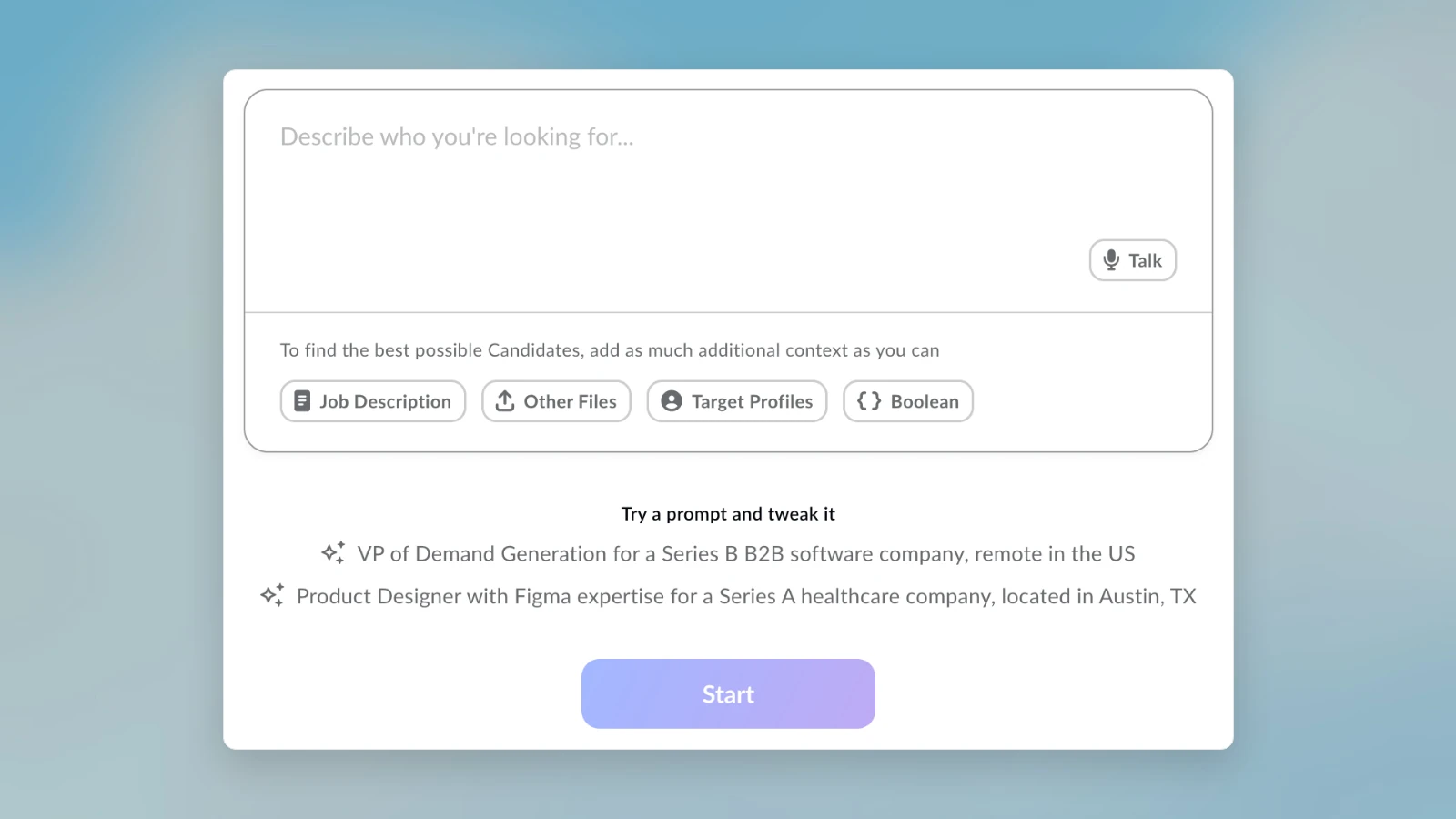
Agentic Job Creation is our answer. Every new job in Loxo now starts the way you'd brief a colleague. You describe the role and add everything you have. Loxo fills in the search and runs the agents you choose.
Loxo is the Talent Intelligence Platform for executive search firms and recruiting agencies. Built around artificial intelligence since 2013. An agentic workforce since August 2026. Agentic Job Creation is just another release within Loxo's larger AI story.
Start with a sentence and whatever context you have
Open Create Job and describe the role in your own words. Type it, or press Talk and say it. Then give Loxo all of the context a good researcher would ask for:
- The job description. Upload it or paste it in.
- Your research brief and any other files. Intake notes, the client's own words, anything you'd hand a colleague.
- Target profiles. Add two or three people who look like the hire and one who looks right on paper but isn't, each with a short note on why.
- Your Boolean, if you want it. It's saved exactly as you typed it. Leave it out if you don't need that precision.
Remember: the more context the better!
If you've already run the Job Intake Agent with the hiring manager, you can start from the completed intake and its answers will help fill in the search.
Loxo turns your brief into the search
From there, you press "Start" and Loxo begins turning your brief into the search: the title, hiring company, locations and time zones, seniority, skills, industries, career trajectories and ranking criteria. Every field is editable, so you can fix anything before the actual job is created.
Say what matters, in order. Put your ranking criteria in the order that matters to the client, and add "Not:" criteria for what should count against someone. It's worth noting that rtanking criteria may change the order of results, but it will never remove anyone. Only the must-haves you confirm will narrow the pool.
See the size of the market before you start. A live estimate shows how many relevant profiles exist, and it updates as you edit.
Know what's left. A Setup checklist shows how complete the search is before you create the job.
Search the same way everywhere. The same Boolean and ranking criteria shape the job's Loxo Source results, so your own sourcing starts from the same brief.
You choose how much the agents do
Loxo's AI agents work on a dial, not a switch — which means you're always in control. Every job is different, so you decide job by job. Turn the Job Description, Longlist and Shortlist agents on or off, and set a range for how many candidates the Longlist Agent adds.
The main takeaway? Nobody is contacted until a person decides. Like we always say: autonomous through the shortlist. Never through the decision.
How to brief a search for a better longlist
None of this is new to a good search consultant. It's how you'd brief a junior on their first day. Here's what to give Loxo on every new job:
- Attach the job description and your brief.
- Add two or three target profiles, each with a note on why they're right.
- Add one profile to avoid, with a note on why.
- Put your ranking criteria in order, and use "Not:" for what should count against someone.
- Use Boolean only when you need precision.
Each longlist sharpens with the context its job gets. That's why the habit matters more than any single search.
Why it matters: your record compounds
Software can only find the person you can describe to it. A sourcing tool takes a query. A Talent Intelligence Platform takes the whole brief: the job description, the research, the people the client admires and the ones they don't, and the order of what matters. It searches your firm's own database and a graph of 850M+ professionals, then hands back a shortlist for you to decide on.
Everything your firm adds stays on its record, so Loxo has more to work with on every search. The more context you give it, the sharper it gets. In 2027, Loxo's memory will learn from all of it.
Agentic Job Creation is release 3 of Phase 1. Phase 1 is one part of NextGen Loxo, which is how the Talent Intelligence Platform replaces the ATS. Release 4 is already in build, and it's about one thing: the quality of every longlist and shortlist.
Who gets it, and when
Agentic Job Creation is rolling out in phases, and more firms get it each week. Your Account Manager can tell you when it reaches your account. The agents run on AI credits that refresh with your plan, and your data stays in your Loxo account, with zero data retention by the underlying AI models.
Compare us page by page. Everyone in this market says AI now. Put Loxo next to your current system and anything else on your list, page by page and live in the product, from the first search to the final invoice. Book a side-by-side demo and we'll run it with you.
Already a Loxo customer? Brief your next search this way, and every one after it.
Ready to shape the future?
Your job is placing the best talent in the roles that will define their careers, their lives, and our future. Our job is making it easier for you to do it.

