How top recruiting teams fix alignment at intake
Every search starts with the exact same conversation. Think of it as you being a runner stepping into the starting blocks: before you launch a multi-week search, you and the hiring manager have to get your footing, stance, and alignment right.
It doesn't matter if you run a retained executive search practice, manage a high-volume direct hire desk, or lead an in-house TA team — every search begins with a recruiter and a hiring manager talking through a role, swapping ideas, and trying to figure out what a successful hire looks like.
By the time THAT meeting ends, dozens of decisions have been made. The problem? Almost none of them get captured well.
There's actually a reason for this. Memory research calls it the Ebbinghaus Forgetting Curve — the idea that humans drop roughly half of what they hear within 24 hours if it isn't structured right away. When a 20-minute conversation packed with subtle requirements gets squeezed into memory and five sentences in a notebook, most of the real intent is gone before sourcing even starts.
What does intake look like today?
If you ask talent leaders across the industry how intake works on their desks, the answers are strikingly consistent. In our research with recruiting teams across executive search, agency, and in-house TA, we hear the exact same reality described over and over:
- It’s messy and fragmented. Information gets scattered across sales calls, follow-up emails, and quick catch-ups with no single place to anchor it.
- A 20-minute conversation gets squeezed into five sentences. Rich dialogue about culture, nuances, and leadership style gets compressed into a tiny handful of bullet points.
- There is no exact process. Every recruiter handles it differently, and the quality of the brief changes depending on who ran the meeting and how fast they could type.
Let’s paint a picture of what happens in modern intake: a recruiter sits on a 20-minute call, listening intently while furiously scribbling notes into Word, Google Docs, Outlook, or a desktop notepad. They walk away with a handful of unstructured bullet points and are expected to launch a complex search from them.
This can’t be categorized as a “competency issue” or “recruiter carelessness” when software was historically built to start managing a search after it already existed in the system. Nobody built a native, structured home for the step that comes before it all. So teams fell back on fragmented spreadsheets, private local drives, and copy-pasting text into an ATS that treats notes like a digital filing cabinet.
In fact, the industry is actively fighting over what to even call this step. Industry leaders like John Vlastelica have long urged talent teams to stop calling it an 'intake' meeting altogether, arguing the term "suggests that I'm here to take notes or take an order — not to lead a conversation."
What’s the cost of getting intake wrong?
When intake isn't structured, critical details get lost in translation — and those lost details compound at every step.
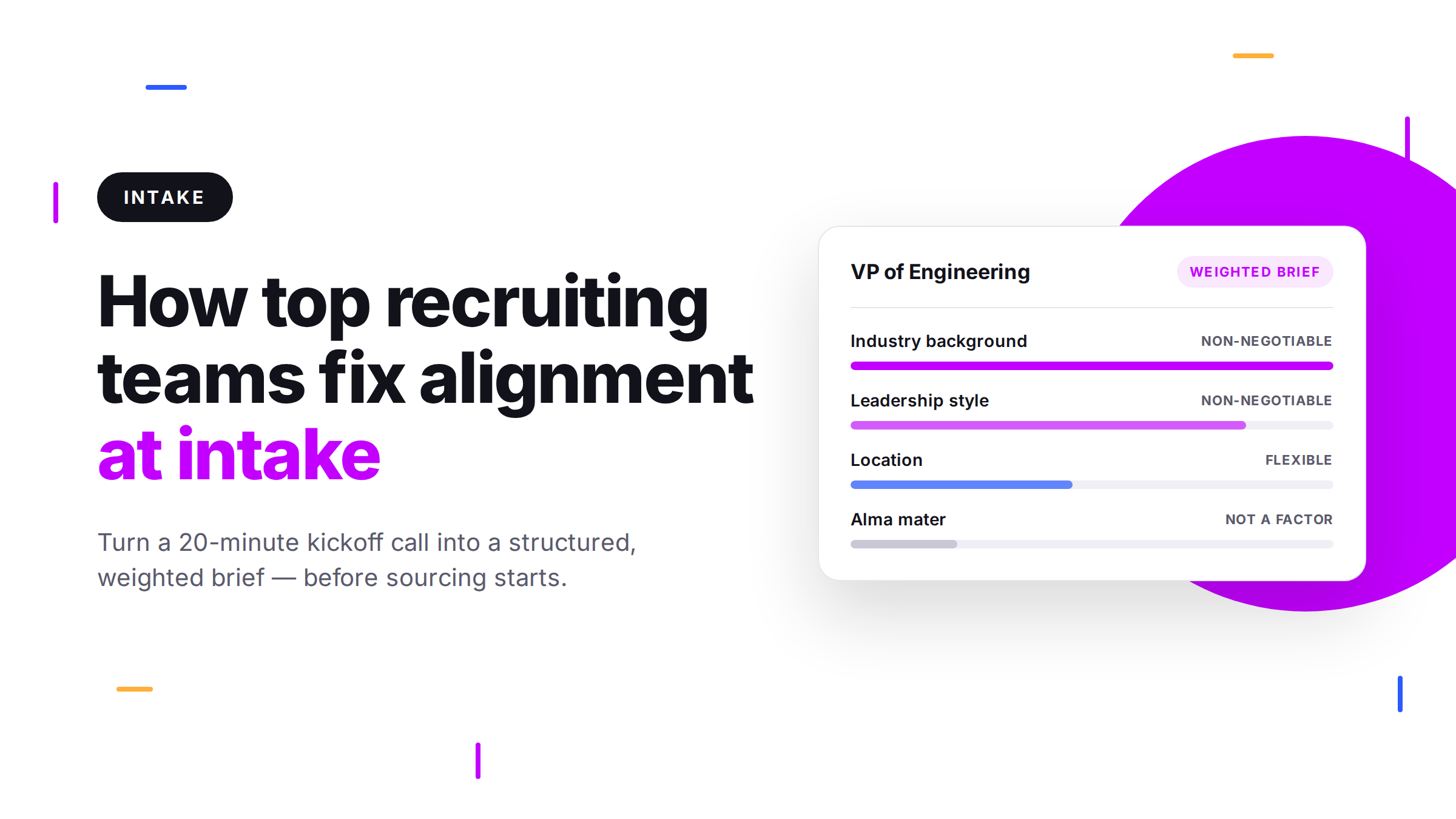
Maybe the hiring manager casually mentioned that industry background matters far more than years of title experience. Maybe they admitted they care deeply about leadership style, but don't care where the candidate went to school. Or maybe a compensation cap was strictly non-negotiable, but location was flexible.
When those details live in a scribbled notebook or one recruiter's inbox, the cost isn't just administrative inconvenience — it ripples across the entire firm:
- Time: Recruiters spend an average of 17.7 hours on administrative work per vacancy — over two full working days per hire (Totaljobs/People Management). When intake intent drifts, searches change requisitions mid-flight, driving up time-to-fill by 38% (Gartner).
- Money: Sourcing candidates based on an imprecise brief leads to wasted outreach cycles, unnecessary candidate rejections, and lost billable momentum.
- Trust: When candidate shortlists miss the mark three weeks into a search, hiring manager confidence erodes.
Where does that leave the hiring manager’s experience?
Hiring managers feel like they are repeatedly answering the same questions, filling out static forms, or receiving unvetted profiles that don't match what they discussed.
It’s been reported that AI drastically improves early collaboration. Searches backed by AI start with a strong recruiter–hiring manager alignment 68% of the time, whereas teams without AI achieve that same level of alignment only 49% of the time. (Metaview 2026 AI & Hiring Alignment Report)
While AI certainly cannot substitute the human element, it serves as a valuable tool to prevent early misalignment in recruitment. By capturing, structuring, and synthesizing thoughts from day one, AI keeps your hiring strategy anchored to its foundational goals even as time goes by.
So, how do we give that initial kickoff meeting the weight it deserves?
The way to give that initial kickoff meeting the importance it deserves is by capturing and weighting requirements as the dialogue actually unfolds, rather than trying to reconstruct them from a notebook later. We built the Intake Agent to bridge this exact gap — transforming informal kickoff conversations into structured role intelligence (that anchors your search from day one), and serving as the front door to the entire Loxo Agent Workforce.
Introducing the Intake Agent
.gif)
The Intake Agent uses conversational AI to turn unstructured kickoff meetings into a clean, weighted brief that captures hiring intent in real time. Because it sits at the very top of your workflow, it creates the foundation everything else flows from — giving your entire search a single, structured source of truth.
Here’s how that looks in practice:
- Structure role weighting: Captures non-negotiables, preferences, and deal-breakers separately, turning messy dialogue into clean, prioritized data.
- Meet hiring managers where they are: Run it live as a collaborative kickoff tool, or hand off a mobile-friendly, guided flow they can knock out on their own schedule.
- Leverage existing knowledge: For returning accounts, Company Snapshot pre-fills historical details automatically, letting you jump straight into what’s new.
- Eliminate the ATS copy-paste tax: One click transforms your agreed-upon brief into an active, ready-to-work Loxo Job record.
Most importantly, this does not replace the conversation or recruiter judgment.
It doesn't turn recruiters into order-takers, nor does it hide decisions inside an automated black box. The recruiter still decides what "good" looks like because conversations still happen. The Intake Agent simply gives that expertise a structured home so intent isn't lost in translation.
Why does structured intake matter for the rest of your search?
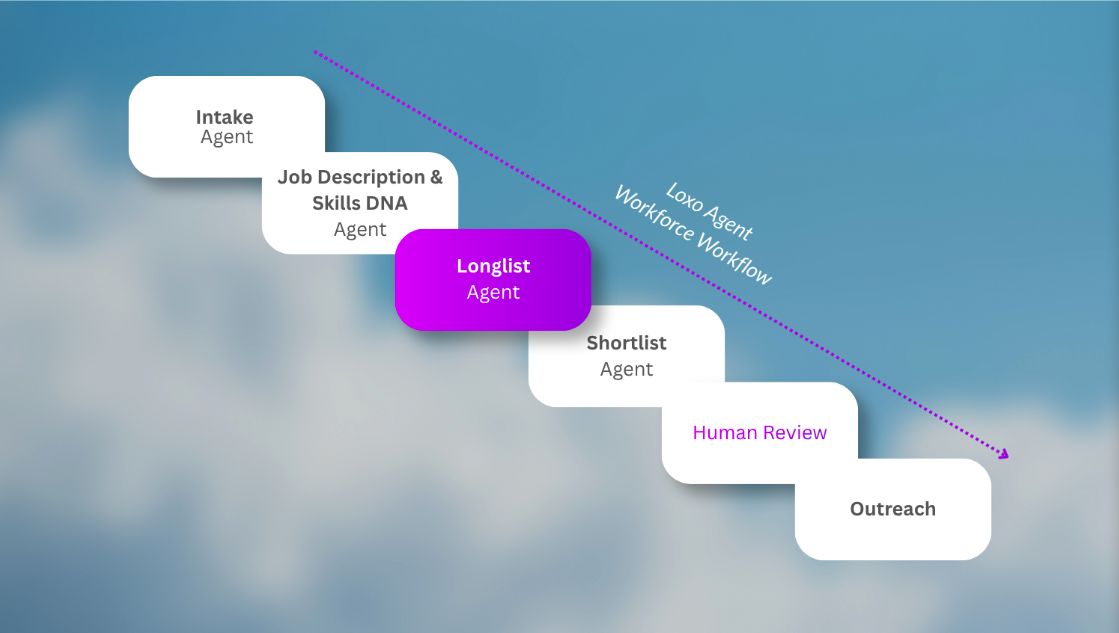
The Intake Agent is the first — and most consequential — gate in the Loxo Agent Workforce pipeline.
The Loxo Agent Workforce is Loxo’s suite of native AI agents designed to execute the end-to-end hiring process alongside you. Think of it as a relay team: the Intake Agent passes structured role requirements to the Job Description & Skills DNA Agent, which shapes the sourcing strategy, which then feeds directly into candidate discovery, longlists, and shortlists. Because every agent reads from the same original truth (Intake and skills DNA), your search compounds in precision at every step.
A world-class intake is now the default — it’s the prompt for your entire pipeline. Because every downstream agent reads from that exact same foundation, your search compounds in precision at every step. Get intake right (weighted, structured, and clear) and every intelligence layer downstream compounds in precision. Get it wrong, and no amount of downstream AI matching can rescue a shortlist built on the wrong brief.
→ Further Reading: Take a look at Truffle’s guide to mastering the recruitment intake call by CEO Sean Griffith for a detailed walkthrough and exact questions to ask hiring managers.
Capture once, compound everywhere
A great race might not be defined in the starting blocks, but having the right starting position can certainly make all the difference.
Elite runners spend enormous amounts of time preparing before they ever step onto the track. They train, refine their technique, study their competition, and prepare for race day. Then, when they get into the blocks, everything they’ve prepared for comes together in one final setup: the right stance, the right alignment, the right position to launch from.
Recruiting is no different.
The intake conversation is that moment in the blocks. It brings together everything you know about the role and turns it into a clear, structured starting point for the search ahead. Get that foundation right, and every step that follows has something precise to build on. Get it wrong, and even the best sourcing strategy, candidate matching, or AI can end up moving in the wrong direction.
That’s why structured intake isn’t just an administrative improvement, but a way for you to preserve the intelligence captured at the start of a search and carry it forward — from the recruiter’s judgment, to sourcing, to candidate evaluation, to the final shortlist.
The Intake Agent gives that kickoff conversation a structured home, using conversational AI to turn dynamic hiring intent into the durable foundation everything else flows from.
Prepare with intent. Capture structure once at intake — and let that prompt compound all the way to the finish line.
<script>
{
"@context": "https://schema.org",
"@graph": [
{
"@type": "BlogPosting",
"@id": "https://www.loxo.co/blog/how-top-recruiting-teams-fix-alignment-at-intake",
"isPartOf": { "@id": "https://www.loxo.co/blog/how-top-recruiting-teams-fix-alignment-at-intake" },
"mainEntityOfPage": { "@id": "https://www.loxo.co/blog/how-top-recruiting-teams-fix-alignment-at-intake" },
"headline": "How top recruiting teams fix alignment at intake",
"alternativeHeadline": "Why structured intake is the prompt for your entire search",
"description": "A 20-minute intake call shouldn't end in five bullet points. How top recruiting teams structure hiring manager alignment with Loxo's Intake Agent.",
"articleSection": "Recruiting Operations",
"inLanguage": "en-US",
"datePublished": "{{2026-08-28}}T09:00:00-05:00",
"dateModified": "{{2028-08-28}}T09:00:00-05:00",
"image": {
"@type": "ImageObject",
"url": "{{OG_IMAGE_URL}}",
"width": 1200,
"height": 630
},
"author": {
"@type": "Person",
"name": "{{AUTHOR_NAME}}",
"jobTitle": "{{AUTHOR_TITLE}}",
"url": "https://www.loxo.co/about",
"worksFor": { "@id": "https://www.loxo.co/#organization" }
},
"publisher": { "@id": "https://www.loxo.co/#organization" },
"about": [
{ "@type": "Thing", "name": "Recruitment intake meeting" },
{ "@type": "Thing", "name": "Recruiter and hiring manager alignment" },
{ "@type": "Thing", "name": "AI recruiting agents" }
],
"mentions": [
{ "@id": "https://www.loxo.co/ai-agents/job-intake#software" },
{
"@type": "Thing",
"name": "Ebbinghaus forgetting curve",
"sameAs": "https://en.wikipedia.org/wiki/Forgetting_curve"
},
{
"@type": "Person",
"name": "John Vlastelica",
"sameAs": "https://blog.recruitingtoolbox.com/blog/2016/08/31/stop-calling-intake-form-please"
}
],
"citation": [
{
"@type": "WebPage",
"name": "UK recruiters lose two days per hire to admin",
"url": "https://www.totaljobs.com/media-centre/uk-recruiters-lose-two-days-per-hire-to-admin-costing-nearly-17k-a-year-in-productivity/"
},
{
"@type": "WebPage",
"name": "Metaview 2026 AI & Hiring Alignment Report",
"url": "https://www.metaview.ai/ai-hiring-alignment-report"
},
{
"@type": "WebPage",
"name": "How to run a recruiting intake meeting (2025)",
"url": "https://hoopshr.com/blog/how-to-run-a-recruiting-intake-meeting-2025/"
}
],
"keywords": "recruitment intake meeting, intake call, hiring manager alignment, recruiting intake process, AI intake agent, structured intake brief",
"wordCount": {{WORD_COUNT}}
},
{
"@type": "FAQPage",
"@id": "https://www.loxo.co/blog/{{SLUG}}#faq",
"isPartOf": { "@id": "https://www.loxo.co/blog/{{SLUG}}#webpage" },
"mainEntity": [
{
"@type": "Question",
"name": "What does the recruiting intake process look like today?",
"acceptedAnswer": {
"@type": "Answer",
"text": "For most teams it is messy and fragmented. Information is scattered across sales calls, follow-up emails, and quick catch-ups with no single place to anchor it. A 20-minute conversation about culture, nuance, and leadership style gets compressed into five sentences typed into Word, Google Docs, or Outlook. There is no consistent process, so the quality of the brief changes depending on who ran the meeting and how fast they could type. Recruiting software was historically built to manage a search after it already exists in the system, so nothing gave the step before it a structured home."
}
},
{
"@type": "Question",
"name": "What is the cost of getting intake wrong?",
"acceptedAnswer": {
"@type": "Answer",
"text": "Lost intake detail compounds at every step of the search. Recruiters already spend an average of 17.7 hours on administrative work per vacancy, and when intake intent drifts, requisitions change mid-flight and time-to-fill rises by 38 percent. Sourcing against an imprecise brief wastes outreach cycles and billable momentum, and when shortlists miss the mark three weeks in, hiring manager confidence erodes."
}
},
{
"@type": "Question",
"name": "Does AI improve recruiter and hiring manager alignment?",
"acceptedAnswer": {
"@type": "Answer",
"text": "Searches backed by AI start with strong recruiter–hiring manager alignment 68 percent of the time, compared with 49 percent for teams without AI, according to the Metaview 2026 AI & Hiring Alignment Report. AI does not substitute for the human conversation or recruiter judgment; it captures, structures, and synthesizes what is said so the search stays anchored to its original intent."
}
},
{
"@type": "Question",
"name": "What is the Loxo Intake Agent?",
"acceptedAnswer": {
"@type": "Answer",
"text": "The Intake Agent uses conversational AI to turn an unstructured kickoff meeting into a clean, weighted brief that captures hiring intent in real time. It structures role weighting by separating non-negotiables, preferences, and deal-breakers; runs live as a collaborative kickoff tool or as a mobile-friendly guided flow a hiring manager completes on their own schedule; pre-fills historical details for returning accounts through Company Snapshot; and converts the agreed brief into an active Loxo Job record in one click, eliminating the ATS copy-paste tax."
}
},
{
"@type": "Question",
"name": "Why does structured intake matter for the rest of the search?",
"acceptedAnswer": {
"@type": "Answer",
"text": "Intake is the first and most consequential gate in the Loxo Agent Workforce. The Intake Agent passes structured role requirements to the Job Description & Skills DNA Agent, which shapes sourcing strategy and feeds candidate discovery, longlists, and shortlists. Because every downstream agent reads from the same original source of truth, precision compounds at each step — and no amount of downstream AI matching can rescue a shortlist built on the wrong brief."
}
}
]
},
{
"@type": "SoftwareApplication",
"@id": "https://www.loxo.co/ai-agents/job-intake#software",
"name": "Loxo Intake Agent",
"url": "https://www.loxo.co/ai-agents/job-intake",
"applicationCategory": "BusinessApplication",
"applicationSubCategory": "Recruiting AI Agent",
"operatingSystem": "Web-based",
"description": "Conversational AI agent that turns unstructured recruiting kickoff meetings into a structured, weighted role brief and a ready-to-work Loxo Job record.",
"isPartOf": {
"@type": "SoftwareApplication",
"name": "Loxo Agent Workforce",
"url": "https://www.loxo.co/ai-agents"
},
"publisher": { "@id": "https://www.loxo.co/#organization" },
"offers": {
"@type": "Offer",
"url": "https://www.loxo.co/pricing",
"priceCurrency": "USD",
"availability": "https://schema.org/InStock"
}
},
{
"@type": "WebPage",
"@id": "https://www.loxo.co/blog/{{SLUG}}#webpage",
"url": "https://www.loxo.co/blog/{{SLUG}}",
"name": "How top recruiting teams fix alignment at intake | Loxo",
"description": "A 20-minute intake call shouldn't end in five bullet points. How top recruiting teams structure hiring manager alignment with Loxo's Intake Agent.",
"isPartOf": { "@id": "https://www.loxo.co/#website" },
"primaryImageOfPage": { "@id": "https://www.loxo.co/blog/{{SLUG}}#article" },
"breadcrumb": { "@id": "https://www.loxo.co/blog/{{SLUG}}#breadcrumb" },
"inLanguage": "en-US"
},
{
"@type": "WebSite",
"@id": "https://www.loxo.co/#website",
"url": "https://www.loxo.co/",
"name": "Loxo",
"publisher": { "@id": "https://www.loxo.co/#organization" },
"inLanguage": "en-US"
},
{
"@type": "Organization",
"@id": "https://www.loxo.co/#organization",
"name": "Loxo",
"url": "https://www.loxo.co/",
"description": "Loxo is a Talent Intelligence Platform combining an ATS, CRM, sourcing, and a native AI Agent Workforce for recruiting teams.",
"logo": {
"@type": "ImageObject",
"@id": "https://www.loxo.co/#logo",
"url": "https://cdn.prod.website-files.com/663b70d752cc952b743d3b67/698b65500ea418d5f740f09c_logo%20black1.svg"
},
"sameAs": [
"https://www.linkedin.com/company/loxo",
"https://www.g2.com/products/loxo/reviews"
]
}
]
}
</script>